
Uncategorized
Why Third-Party Testing Is Essential for Research Peptides
Nov
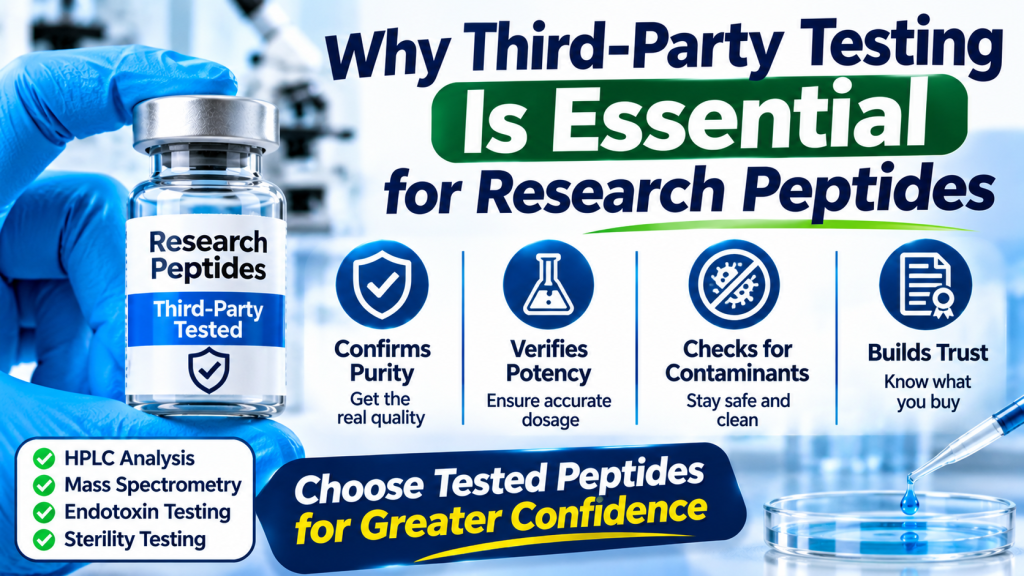
In the research peptide market, a certificate of analysis is only as trustworthy as the laboratory that produced it. That is why third-party testing is essential: an independent lab verifies identity, purity, and safety data without any commercial stake in the result. For researchers, buyers, and quality managers evaluating suppliers in the United States, independent verification is the difference between documented quality and marketing language. This guide explains what third-party testing covers, how to read a lab report, and how to vet a supplier before you buy.
At HK Peptides Worldwide, independent analysis sits at the center of the quality conversation because compound identity and purity affect every downstream research outcome.
What Third-Party Testing Means in the Peptide Supply Chain
Third-party testing refers to analysis performed by a laboratory that is independent of the manufacturer, distributor, or seller. The lab has no financial incentive to report favorable results, which is what separates it from in-house quality control.
In-house testing still matters. A responsible producer runs routine checks during synthesis and before release. The limitation is structural: when the same organization produces, tests, and sells a product, a buyer has only that organization’s word that the data is accurate.
Independent testing adds a layer the seller cannot easily override. It also creates a paper trail a researcher can request and compare against the product in hand.
First-Party, Second-Party, and Third-Party Testing Compared
- First-party testing: the manufacturer tests its own output internally.
- Second-party testing: the buyer or a closely affiliated party performs the check.
- Third-party testing: a fully independent accredited or qualified laboratory analyzes the sample.
For research peptides, the third category carries the most weight because it removes the conflict of interest. Many buyers now treat an independent lab report as the baseline requirement rather than a premium feature.
Why Independence Matters More Than Brand Reputation
Reputation is useful but not verifiable on its own. A supplier can describe itself as premium, pharmaceutical-grade, or lab-tested without publishing anything a buyer can check.
An independent report converts claims into evidence. It names the laboratory, states the method, and reports measured values. That documentation is the foundation of supplier transparency and quality documentation that serious researchers rely on.
Core Tests Every Peptide Certificate of Analysis Should Include
A peptide certificate of analysis (CoA) is only useful if it reports the right tests. Four categories matter most: identity, purity, quantity, and sterility or endotoxin status where applicable.
Purity by HPLC
High-performance liquid chromatography (HPLC) separates components in a sample and reports the percentage of the target peptide. A purity figure below roughly 95 percent usually signals residual impurities that could complicate sensitive assays.
The CoA should state the chromatographic method, the detection wavelength, and the integration result. A single percentage without method details is difficult to interpret and worth questioning.
Identity Confirmation by Mass Spectrometry
Mass spectrometry verifies molecular weight and confirms the compound is what the label says. This matters because mislabeled or substituted peptides are a documented risk in gray markets.
HPLC purity alone cannot confirm identity; a sample can be pure and still be the wrong molecule. Identity testing closes that gap and should appear alongside purity data on any credible report.
Water Content, Counterion, and Net Peptide Content
Two products can both read 98 percent purity and deliver different amounts of active peptide. Residual moisture and counterions such as acetate or trifluoroacetate account for part of the difference. Net peptide content, sometimes called peptide content, reconciles the purity figure with the actual mass in the vial.
Researchers calculating molar concentrations need this number. When a CoA omits it, mass-based dosing becomes an estimate rather than a measurement.
Sterility and Endotoxin Testing
Products labeled sterile should carry sterility testing, often using membrane filtration or direct inoculation methods. Endotoxin testing by Limulus amebocyte lysate (LAL) assay indicates bacterial contamination risk.
These tests are not universal for every product. They matter most for injectable-route research and for any work involving cell culture, where contamination can invalidate results before the study begins.
Heavy Metals and Residual Solvents
Elemental impurity testing screens for heavy metals, and residual solvent testing checks for manufacturing residues. Both appear in pharmacopeial standards and in reputable analytical workflows. Their absence from a CoA is not automatically disqualifying, but it narrows the assurance a buyer can claim.
How to Read and Verify a Certificate of Analysis
Most buyers glance at the purity number and stop there. A careful reading covers the laboratory, the sample identity, the methods, and the date, because each element affects how much weight the report deserves.
What a Complete CoA Contains
A reliable report typically includes:
- The testing laboratory’s name and contact details
- The product name, lot or batch number, and sample receipt date
- The methods used, with instrument types where relevant
- Measured results against stated specifications
- Analyst or reviewer signatures and a report date
Missing lot numbers are a common red flag. A report that cannot be tied to a specific batch does not verify the vial you received.
How to Cross-Check a CoA
Start with the batch number on the vial and match it to the report. Then look for the laboratory’s own website and confirm the report format matches what that lab publishes. A cautious buyer may also contact the lab to verify that a report exists, since fabricated or altered certificates circulate in some markets.
Compare results against specifications rather than against marketing claims. A specification of at least 98 percent purity with a measured result of 98.6 percent is a coherent record; a measured result that exceeds 100 percent suggests a reporting error.
Red Flags in Peptide Documentation
- Certificates with no laboratory name, letterhead, or contact information
- Purity claims with no method described
- Reports dated before the batch was manufactured
- Identical CoAs reused across multiple products or lots
- Screenshots rather than original documents, which are easier to alter
Each flag is a prompt for questions, not automatic proof of fraud. The point is to ask before purchase rather than after.
Why Third-Party Testing Is Essential for Research Integrity
Independent testing protects the study as much as the buyer. Contaminated or misidentified material can produce data that looks valid but cannot be reproduced, wasting reagents, instrument time, and months of work.
Reproducibility Starts With Verified Material
Reproducibility is a core principle in scientific research, and it begins with knowing exactly what went into an experiment. The National Institute of Standards and Technology publishes reference materials and measurement guidance that many labs use to anchor quality practices across disciplines.
When a peptide’s identity and purity are documented, a failed assay points to the method rather than the material. When they are not, every unusual result carries a second explanation that must be ruled out.
Contamination and Mislabeling Risks
Endotoxins, residual solvents, and cross-contamination from synthesis equipment can distort biological assays. Mislabeling poses a different risk: a vial that contains a related analog or a degraded fragment may behave unpredictably.
Researchers have documented widespread quality variability in peptides sold online in peer-reviewed analyses. Independent verification addresses that variability at the point of sale.
Regulatory and Institutional Context
In the United States, the Food and Drug Administration does not approve research peptides as drugs when sold for laboratory research use. Legitimate suppliers label products “not for human consumption” for that reason, and buyers use them only in research settings.
Institutional review boards and environmental health and safety offices may ask for documentation of materials used in funded studies. A complete CoA with third-party results supports that requirement and strengthens grant or audit records.
What Third-Party Testing Means for Buyers and Sellers
Independent testing serves both sides of the transaction. Buyers gain verifiable evidence; sellers gain a defensible quality record that distinguishes them from sellers who rely on claims alone.
Benefits for Researchers and Procurement Teams
Procurement teams benefit from a standardized evaluation criterion. Instead of comparing adjectives, they compare test panels, methods, and measured values across suppliers.
Researchers gain confidence that concentrations calculated from mass are accurate, especially when net peptide content is reported. They also gain a diagnostic tool: if an assay fails, the material’s documentation is already in hand.
Benefits for Suppliers
A supplier that publishes independent results builds trust faster. Buyers who trust the documentation tend to reorder and refer colleagues, which lowers acquisition costs over time. Access to reliable research-grade peptide supplies with clear documentation shortens procurement cycles for repeat buyers.
Transparency also reduces disputes. When a buyer questions a result, the conversation moves to a shared document rather than competing assertions.
Cost and Turnaround Considerations
Independent testing adds cost per batch, and the price usually appears in the product’s price rather than as a separate line item. HPLC, mass spectrometry, sterility, and endotoxin panels performed by accredited labs are not inexpensive.
Buyers should view that cost as insurance against wasted experiments, not as overhead. Turnaround time is typically days to a few weeks depending on the panel and laboratory queue, which is one reason batch testing happens before release rather than on demand.
Limitations to Understand
Third-party testing is a snapshot of a batch, not a guarantee of every vial. Sampling methods affect how representative a result is.
Testing also cannot confirm how a product was stored after release or how it was handled in transit. Cold-chain integrity, light exposure, and reconstitution practices all influence stability. A strong CoA covers the batch at release; the buyer’s handling covers everything after.
How to Choose a Supplier That Tests Independently
The practical question is not whether a supplier claims independent testing, but whether it can demonstrate it on request. A short, disciplined checklist separates documentation from marketing.
Questions to Ask Before You Buy
- Which laboratory performs your testing, and is it accredited?
- Can you send the full CoA for this exact lot before purchase?
- Does the report include HPLC purity, mass spectrometry identity, and net peptide content?
- Are sterility and endotoxin results available for products labeled sterile?
- How are products stored and shipped, and what temperature controls apply?
Documented answers to these questions are more informative than any quality claim on a product page. Suppliers who publish their quality and testing standards make this step faster.
Signs of a Documentation-First Supplier
A documentation-first supplier lists lot numbers on vials, publishes CoAs matching those lots, and answers technical questions with specifics rather than superlatives. It also states clearly that products are for research use only.
That combination, independent reports and clear labeling, is what third-party testing is essential for in practice. It turns quality from a promise into a record.
Frequently Asked Questions
What does third-party testing mean for peptides?
It means an independent laboratory, separate from the manufacturer and seller, analyzes the product and reports identity, purity, and related quality data. The independence removes the conflict of interest that exists when a producer tests its own output.
How can I verify a peptide certificate of analysis?
Match the lot number on the report to the vial, confirm the laboratory exists, and check that the report includes methods and measured results. Contacting the lab to confirm the report is a reasonable extra step for high-value purchases.
What purity should a research peptide have?
Many suppliers specify at least 95 percent by HPLC, and many researchers prefer 98 percent or higher for sensitive work. The right threshold depends on the assay, but the number should always come with method details and a lot number.
Does third-party testing guarantee a product is safe?
No. It verifies the batch against defined tests at a point in time. Safety also depends on storage, handling, and intended use, and researchers should follow institutional and regulatory guidance for their setting.
How often should batches be tested?
Testing should occur per batch before release, not once per product line. Manufacturing variability means results from one lot do not automatically apply to the next.
Is third-party testing required by law in the United States?
The FDA regulates drug products but does not approve research peptides sold for laboratory use, and it does not mandate independent testing for every research chemical sold. Requirements vary by product category and institution, so buyers should confirm the standards that apply to their work rather than assume a universal rule.
