
Uncategorized
Pharmaceutical vs. Research Grade: What the Difference Means for Peptide Buyers
Nov
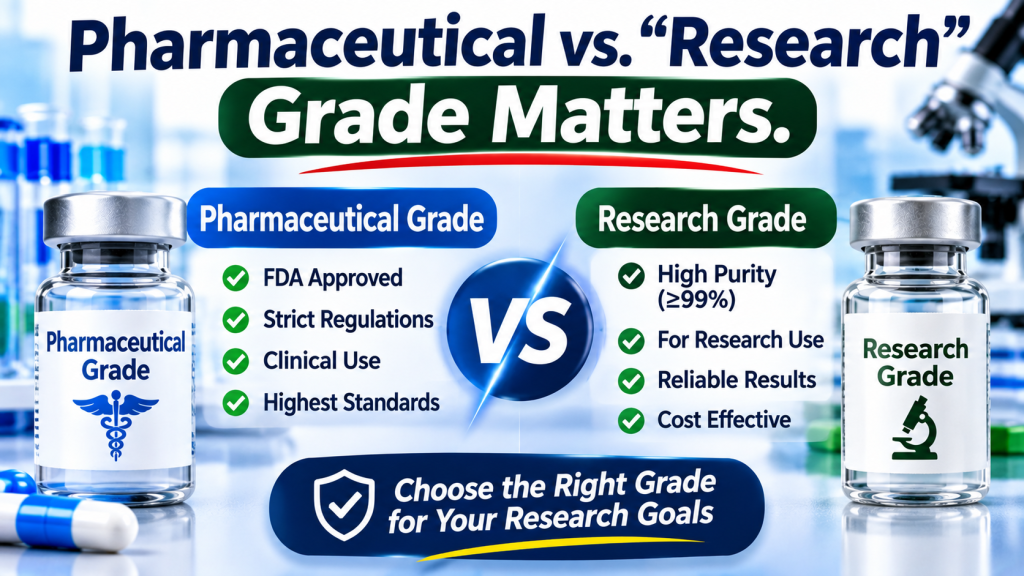
If you have ever compared peptide product listings, you have probably noticed that some are labeled pharmaceutical grade while others are sold as research grade. The pharmaceutical vs. research grade distinction is one of the most important — and most misunderstood — differences in the peptide market. It affects purity, testing, intended use, legal status, and how you should interpret a certificate of analysis. This guide breaks down what each label actually means in the United States, where the lines blur, and how to evaluate a supplier before you buy.
The short answer: “pharmaceutical grade” refers to a product manufactured under strict regulatory frameworks for human medicinal use, while “research grade” describes material intended strictly for laboratory research and not for human consumption. The two are not interchangeable, even when the chemical name on the label is identical. Understanding that gap helps you read labels critically and ask better questions of any vendor — including those you find through specialty suppliers like HK Peptides Worldwide.
What “Pharmaceutical Grade” Actually Means
Pharmaceutical grade is a regulatory and manufacturing designation, not a marketing flourish. In the U.S., a product earns this label by being made under current Good Manufacturing Practices (cGMP) and, for drugs, by holding an approved application or otherwise lawful status with the Food and Drug Administration. Sterility, potency, stability, and labeling all fall under enforceable standards.
That regulatory backbone is what separates pharmaceutical grade from everything else. When a product is pharmaceutical grade, an independent authority has reviewed the facility, the processes, and the claims. Batch-to-batch consistency is expected and auditable, and deviations can trigger recalls or enforcement action.
The Regulatory Backdrop Buyers Should Know
The FDA’s oversight of compounded and manufactured drugs is central to this conversation. So is the distinction between an FDA-approved drug and a compounded preparation made by a licensed pharmacy under a prescription. Both can involve high standards, but they are governed differently and carry different assurances. The agency’s own resources on compounding and drug quality are worth reading if you want to understand the rules that underpin the “pharmaceutical” label.
Why the Label Commands a Premium
Pharmaceutical-grade products cost more because compliance is expensive. Facility validation, environmental monitoring, analytical testing, documentation, and regulatory review all add cost. The premium reflects a verifiable chain of accountability that research-grade products typically do not carry.
What “Research Grade” Really Describes
Research grade signals intended use, not necessarily low quality. It means the material is sold for laboratory and analytical purposes — such as in vitro studies, assay development, or instrument calibration — and is explicitly not for human or veterinary use. Legitimate suppliers repeat this disclaimer because it is legally and ethically meaningful.
Here is where confusion creeps in. Research grade is not a single, regulated standard. Two vendors can both sell “research grade” peptides of wildly different purity and testing rigor. One may provide third-party high-performance liquid chromatography (HPLC) and mass spectrometry results for every batch; another may offer nothing beyond a generic label. The term itself guarantees little on its own.
That is why the pharmaceutical vs. research grade comparison is really a comparison between a regulated standard and a self-declared category. Buyers have to do more diligence with the latter.
Purity Percentages Are Not Created Equal
A “99% pure” claim sounds impressive, but purity is only as meaningful as the method behind it. HPLC purity tells you how much of the detected material is the target compound; it does not tell you what the remaining percentage is, whether the assay was validated, or whether the sample was drawn from the actual batch you will receive. Ask which method was used, who ran it, and whether the report is batch-specific.
Certificates of Analysis: Read Them Closely
A certificate of analysis (CoA) is the single most useful document a research-grade buyer can request. A credible CoA includes the compound name, batch or lot number, test methods, measured results, and the testing laboratory’s identity. Vague certificates with no lot number or no lab name are a red flag. For buyers comparing options, reviewing how suppliers document quality is a practical first step before placing any order.
Pharmaceutical vs. Research Grade: A Side-by-Side Comparison
The clearest way to see the differences is to line them up across the factors that matter most to buyers.
Manufacturing and Oversight
Pharmaceutical-grade production runs inside inspected, validated facilities under cGMP and ongoing regulatory scrutiny. Research-grade production varies widely; some suppliers operate clean, well-documented labs, while others offer little transparency. The presence of a quality management system — and evidence of it — is the dividing line.
Testing and Documentation
Pharmaceutical-grade products come with documented testing tied to regulatory submissions and batch release. Research-grade testing ranges from comprehensive third-party analysis to essentially none. Neither label tells you the purity of a specific vial; only batch-specific documentation does.
Intended Use and Legal Status
This is the crux. Pharmaceutical-grade drugs are intended for use under medical supervision and are lawful only through appropriate channels. Research-grade materials are labeled “not for human consumption” and are sold for laboratory use. Using a research-grade product in a way inconsistent with its labeling shifts risk and, potentially, legal exposure onto the buyer.
| Factor | Pharmaceutical Grade | Research Grade |
|---|---|---|
| Primary standard | cGMP and FDA oversight | Supplier-declared; unregulated category |
| Intended use | Human medicinal use (with authorization) | Laboratory and analytical use only |
| Testing | Required, documented, batch-linked | Voluntary; varies by supplier |
| Consistency | Expected and auditable | Depends entirely on the vendor |
| Typical buyer | Licensed healthcare and pharmacy channels | Researchers and laboratories |
Why the Distinction Matters Most to Researchers
For academic and industry researchers in the U.S., the grade question is not just about purity — it is about reproducibility. A study that depends on a compound of uncertain purity or identity is hard to replicate, and replication is the currency of credible science. Using well-documented, batch-traceable material protects the integrity of your results and your lab’s reputation.
Institutions increasingly expect procurement documentation, and some require CoAs and supplier qualification before purchase. A supplier that cannot produce batch-specific testing will struggle to meet those standards. If your work feeds into grants, publications, or regulated environments, the paper trail is as important as the product.
Matching the Grade to the Application
Not every project needs the same rigor. Early-stage exploratory work may tolerate broader specifications, while analytical method development, reference standards, and anything feeding into regulated submissions demand tight tolerances. Decide what your application requires before you shop, then hold every supplier to that bar rather than letting marketing language set your standard.
How to Evaluate a Supplier’s Quality Claims
Both labels are only as good as the evidence behind them. Whether you are buying pharmaceutical or research grade, a few practical checks separate serious suppliers from casual ones.
- Ask for batch-specific documentation. A CoA that matches your lot number is far more valuable than a sample report.
- Identify the testing lab. Third-party analysis from a named, independent lab carries more weight than in-house-only testing.
- Look for method detail. HPLC and mass spectrometry are standard for identity and purity; confirm both were performed.
- Check the disclaimers. A research supplier should clearly state products are not for human use. Vagueness here is a warning sign.
- Test the responsiveness. Clear, specific answers to technical questions signal a supplier that understands its own products.
For buyers navigating these questions, comparing suppliers on documentation and transparency is more informative than comparing price alone.
Common Misconceptions About Grading
“Research grade” is a formal standard.
It is not. Unlike pharmaceutical grade, research grade has no single regulator or universal definition. Treat it as a description of intended use, not a certification.
Higher purity always means pharmaceutical grade.
Purity is one attribute. Pharmaceutical grade also implies manufacturing controls, regulatory review, and lawful status for human use — none of which high purity alone provides.
The labels are just marketing.
Pharmaceutical grade is anchored in real regulation. Research grade is far looser, which is exactly why buyers must scrutinize the supplier.
Grade tells you everything about the product.
It does not. Batch-level testing and traceability remain the most reliable indicators of what is actually in the vial.
Frequently Asked Questions
What is the main difference between pharmaceutical and research grade?
Pharmaceutical grade is manufactured and overseen under regulatory standards for human medicinal use, while research grade is intended for laboratory work only and is not for human consumption. The regulatory oversight, not the chemical name, is the core difference.
Is research grade lower quality than pharmaceutical grade?
Not automatically. Quality depends on the specific supplier’s manufacturing and testing. Research grade is an unregulated category, so two products under that label can differ dramatically in purity and documentation.
Can I use research grade peptides for human use?
No. Research-grade products are explicitly labeled not for human consumption. Using them otherwise conflicts with their intended use and can carry legal and safety risks.
Does a certificate of analysis guarantee quality?
A CoA is strong evidence when it is batch-specific, names an independent lab, and lists test methods and results. A vague or generic CoA provides little assurance, so read it critically.
Are research grade peptides legal in the United States?
Legality depends on the specific compound and how it is marketed and used. Research-only labeling matters here, and buyers should understand the rules for their particular situation rather than assume broad legality.
How can I verify a supplier’s claims?
Request batch-specific CoAs, confirm which third-party lab performed testing, and review whether the supplier clearly states intended-use disclaimers. Consistent, specific answers are a good sign.
The Bottom Line for U.S. Buyers
The pharmaceutical vs. research grade distinction comes down to regulation, documentation, and intended use. Pharmaceutical grade carries enforceable manufacturing and oversight standards for human medicinal purposes. Research grade is a broad, largely self-declared category meant for laboratory work — and its quality depends entirely on the supplier behind it.
For researchers and buyers in the U.S., the practical takeaway is to let evidence set your expectations. Demand batch-specific testing, read certificates carefully, and confirm a supplier’s disclaimers are clear. Whether you are stocking a lab or evaluating vendors through HK Peptides Worldwide, the questions are the same — and the answers tell you far more than any single label.
