
Uncategorized
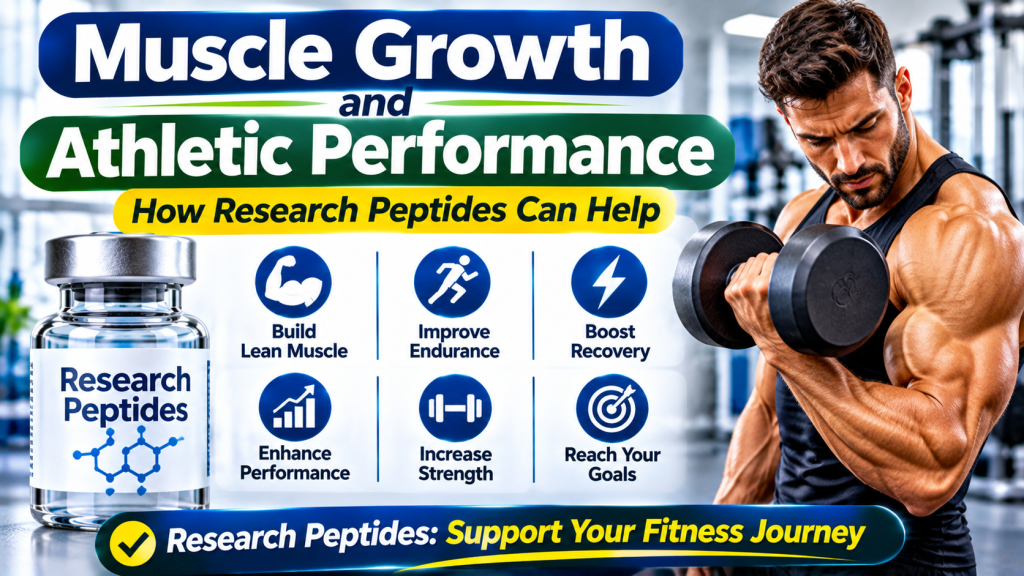
Muscle Growth and Athletic Performance: How to Choose Research-Grade Peptides That Support Real Results
Nov
Athletes and serious lifters searching for muscle growth and athletic performance products face a crowded, confusing market. This guide explains what actually drives hypertrophy and recovery, which categories of products are worth your money, and how to evaluate a supplier before you buy. It focuses on research peptides sold for laboratory use, because that is where most buyer questions — and most risk — currently sit.
The content assumes a U.S. audience of experienced recreational lifters, competitive athletes, coaches, and independent researchers who want clear buying criteria rather than hype. If you are earlier in your training journey, the fundamentals covered here still apply; you will simply get more value from the recovery and sourcing sections than from the product-category comparisons.
What Muscle Growth and Athletic Performance Really Depend On
Hypertrophy is a training stimulus plus recovery equation. Progressive resistance training creates the signal, and adequate protein, sleep, and calorie intake allow the body to build tissue. No product substitutes for that foundation, and any supplier implying otherwise is telling you something useful about their credibility.
Athletic performance adds a second layer: power output, speed, endurance, and skill execution. These depend on neuromuscular adaptation, conditioning, and body composition. Supplements and research compounds may influence the margins — recovery speed, appetite, body composition — but the margins are where competitive athletes actually compete.
That distinction matters for buyers. A product marketed for “muscle growth and athletic performance” should be evaluated on what mechanism it targets and whether human evidence supports that mechanism, not on how bold the label copy is.
Training variables that drive hypertrophy
- Mechanical tension: Loaded stretching and heavy sets near failure remain the strongest hypertrophy driver.
- Volume and frequency: Roughly 10–20 hard sets per muscle group per week suits most intermediate lifters, adjusted for recovery.
- Progressive overload: Small, tracked increases in load or reps over months, not week to week.
- Protein intake: Commonly cited guidance sits around 1.6 g per kg of bodyweight per day for trained lifters, with some benefit at higher intakes.
Recovery variables that protect performance
Sleep duration and quality, calorie sufficiency, stress management, and deload scheduling do more for performance than most products on the market. Buyers who fix these first tend to report better outcomes from everything else they purchase.
Where Peptides Fit Into the Muscle Growth and Athletic Performance Conversation
Peptides are short chains of amino acids. In research settings, several have been studied for their effects on growth hormone secretion, tissue repair, appetite, and body composition. That is the honest framing: research settings, with varying levels of evidence and regulatory status.
Many peptides discussed in fitness communities are not approved by the U.S. Food and Drug Administration for athletic or body-composition use. Some appear on restricted lists, and athletic organizations may prohibit them under anti-doping rules. Buyers should verify status with the U.S. Anti-Doping Agency and the FDA before purchasing anything, and should treat any seller promising specific physique outcomes as a red flag.
The legitimate buyer in this category is usually a researcher sourcing reference materials, or an informed consumer making a personal decision with full knowledge of the legal and health picture. Both groups need the same things: identity-verified compounds, third-party testing, transparent documentation, and cold-chain shipping.
Categories buyers commonly research
| Category | Typical research interest | Buyer caution |
|---|---|---|
| Growth hormone secretagogues | Pulsatile GH release, body composition | Regulatory status varies; doping prohibitions apply |
| Repair and recovery peptides | Connective tissue, skin, gut lining | Human data often limited or preliminary |
| Metabolic and appetite-related peptides | Energy balance, body composition | Prescription status common in the U.S. |
| Collagen and amino acid blends | Tendon and joint support | Food-supplement regulatory path, not research-grade |
A practical rule: if a category is legally sold as a dietary supplement, judge it like a supplement. If it is sold as a research chemical, judge it like a laboratory reagent — because that is the legal frame the seller is using.
How to Evaluate a Peptide Supplier Before You Buy
Supplier quality separates useful purchases from wasted money. The market has no universal certification, so buyers must apply their own checklist. Start with batch documentation and work backward toward the seller’s incentives.
Look for a certificate of analysis that matches the batch number on your vial, not a generic PDF. Ask whether testing was performed by an independent lab and whether the report covers identity, purity by HPLC, and mass confirmation. Sellers who publish real documentation invite scrutiny; sellers who publish stock photos of vials usually do not.
The buyer’s documentation checklist
- Batch-matched COA with a visible lot number
- HPLC purity trace and mass spectrometry confirmation
- Independent lab name you can look up
- Clear labeling of form, quantity, and storage requirements
- Cold-chain or insulated shipping for temperature-sensitive compounds
- Published policies on returns, reshipping, and order disputes
If a site buries this information or answers questions only through a chat widget, treat that as a signal. For context on what accountable sourcing looks like in this market, review the quality and sourcing standards published by HK Peptides Worldwide, then hold every other supplier to the same bar.
Red flags that predict a bad purchase
Vague purity claims without numbers, prices far below market, pressure tactics and countdown timers, before-and-after photos of unnamed athletes, and any promise of specific muscle gain or performance outcomes. Real research suppliers speak in specifications.
Product Forms, Handling, and Storage for Serious Buyers
How a product is shipped and stored affects what you actually receive. Lyophilized (freeze-dried) powders are generally more stable in transit than reconstituted solutions, and most research vials are sold in that form. Reconstitution, if you do it, requires bacteriostatic or sterile water and careful technique.
Temperature control matters. Many peptides degrade with repeated freeze-thaw cycles or prolonged heat exposure, which is why summer shipping is a common failure point for discount sellers. Reputable suppliers use insulated packaging and, in hot months, cold packs.
Questions to ask about handling
- Is the product shipped lyophilized, and with what desiccant?
- What storage temperature does the supplier specify before and after reconstitution?
- Is the vial amber or clear, and does it have a septum suitable for repeated draws?
- Does the label include a lot number and a beyond-use recommendation?
For general laboratory guidance on handling and stability of biological materials, university research safety pages and the National Institutes of Health are useful starting references.
Building a Purchase Plan Around Your Training Goals
Transactional buyers benefit from matching a purchase to a specific, measurable goal. “Get bigger and perform better” is not a goal; “add lean mass over a 16-week block while maintaining sprint speed” is. The narrower the goal, the easier it is to judge whether a product earned its place in your routine.
Structure your plan in phases. First, audit training and nutrition for four to six weeks with no new purchases. Second, identify the specific bottleneck — recovery, appetite, joint irritation, sleep — that a product might address. Third, buy one item, document the batch, and track outcomes for a defined period before adding anything else.
A simple four-phase framework
- Audit: Log training volume, protein intake, sleep hours, and body weight for four weeks.
- Target: Pick a single limiting factor and the product category that addresses it.
- Test: Run one product for a fixed window with pre-defined metrics — lifts, body weight, sleep quality, joint comfort.
- Review: Keep, stop, or replace based on your own data, not forum anecdotes.
This framework also protects your budget. Athletes who buy methodically spend less and learn more than those who chase every new compound. It pairs well with the broader research product catalog at HK Peptides Worldwide if you prefer to compare categories in one place before committing.
Legal, Safety, and Anti-Doping Considerations in the U.S.
This section is not optional reading. The U.S. regulatory picture for peptides is genuinely uneven: some compounds are prescription drugs, some are sold as dietary supplements, and many are marketed as “not for human consumption” research chemicals. Buyers should understand which bucket a product falls into before checkout.
Athletes subject to drug testing face an additional layer. Anti-doping codes prohibit many growth hormone–related and metabolic compounds regardless of where or how they were purchased. A product being legal to buy does not make it legal to use in competition, and ignorance is not a defense in a doping case.
Safety considerations are equally concrete. Unverified purity means unknown contaminants, incorrect dosing information, and no assurance of sterility. Anyone with a medical condition, anyone taking prescription medication, and anyone under 18 should consult a licensed physician rather than self-directing research compounds.
What to verify before you buy
- The compound’s U.S. regulatory classification
- Whether your sport or federation prohibits it
- The supplier’s testing documentation for the exact batch
- Your own health status and medication interactions with a clinician
Common Mistakes That Undermine Muscle Growth and Athletic Performance
Most disappointing purchases trace back to process errors, not bad luck. The first is buying before auditing training. The second is buying several new products at once, which makes outcomes impossible to attribute. The third is trusting a supplier’s marketing page over its lab documentation.
A fourth mistake deserves its own line: ignoring shipping conditions. A perfectly pure peptide that sits in a hot delivery truck for three days is no longer a perfectly pure peptide. Buyers in warm U.S. states should specifically ask about summer shipping practices.
The fifth is treating a purchase as a substitute for coaching or clinical advice. Products support a plan; they do not replace one.
FAQ
Are peptides legal to buy in the United States?
It depends on the specific compound. Some are prescription-only, some are sold as dietary supplements, and others are marketed as research chemicals not intended for human use. Check the FDA’s position on the specific substance and consult a professional before purchasing.
Do peptides actually build muscle?
Evidence varies widely by compound. Some have been studied for effects on growth hormone secretion or body composition, but human data for most fitness-marketed peptides is limited. Training, protein intake, and sleep remain the primary drivers of muscle growth.
How do I verify peptide purity?
Request a batch-matched certificate of analysis showing HPLC purity and mass spectrometry confirmation from an independent lab. Compare the lot number on the report to the lot number on your vial. Suppliers who cannot provide this should be avoided.
Can tested athletes use research peptides?
Many peptide compounds are prohibited under anti-doping codes regardless of legal purchase status. Check the World Anti-Doping Agency prohibited list and your own federation’s rules before purchasing or using anything.
What should I look for in a peptide supplier?
Batch-specific testing documents, independent lab reports, clear labeling with lot numbers, proper cold-chain or insulated shipping, and published order policies. Transparency about specifications matters more than marketing claims.
How should peptides be stored?
Most are shipped lyophilized and should be stored cool and dry, protected from light, per the supplier’s specification. Avoid repeated freeze-thaw cycles and prolonged heat exposure, and follow the supplier’s guidance after any reconstitution.
