
Uncategorized
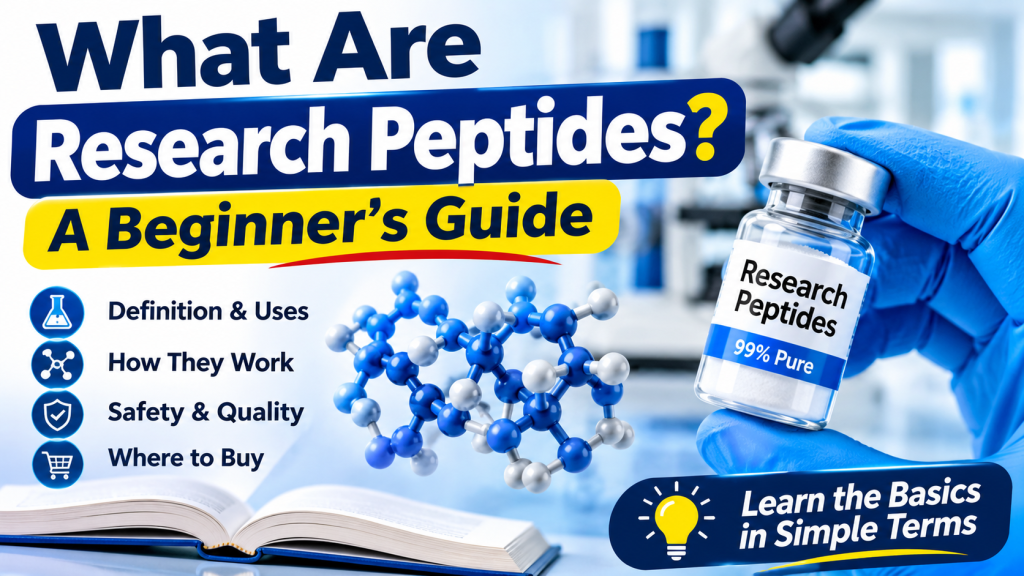
What Are Research Peptides? A Beginner’s Guide
Nov
Research peptides are short chains of amino acids manufactured for laboratory and scientific study rather than for human consumption. If you have seen peptides discussed in fitness forums, research blogs, or news coverage and want a clear, no-hype explanation of what they actually are, this beginner’s guide walks through the fundamentals: what peptides are, how they differ from proteins and drugs, how researchers handle them, and what the common questions and cautions are.
Peptides sit at an interesting crossroads of biology, chemistry, and regulation. They are studied in academic labs, pharmaceutical development, and analytical testing environments. Understanding the basics helps you read peptide-related content critically and separate genuine science from marketing noise. This guide keeps the focus on education and laboratory context, not on personal use.
Peptide Basics: What Exactly Is a Peptide?
A peptide is a molecule made of amino acids linked together by peptide bonds. When two amino acids join, you get a dipeptide; a handful of amino acids form an oligopeptide; and longer chains are generally called polypeptides. Proteins are also amino acid chains, so the line between “peptide” and “protein” is largely a matter of length and structure rather than a sharp biological boundary.
In practical terms, most compounds described as research peptides fall somewhere between roughly a few amino acids and several dozen. Their short length matters because it influences how they fold, how stable they are, and how they behave in laboratory assays. You can explore the broader chemistry of amino acids and peptide bonds through resources such as Wikipedia’s overview of peptides, which is a reasonable starting point for terminology.
Peptides vs. Proteins vs. Drugs
Peptides are sometimes confused with proteins and with pharmaceutical drugs, so it helps to separate the terms:
- Proteins are typically long, complex amino acid chains that fold into specific three-dimensional shapes to perform cellular functions.
- Peptides are shorter chains that may act as signaling molecules, fragments of larger proteins, or synthetic research tools.
- Drugs are a regulatory category, not a chemical one. A peptide can become a regulated medicine once it is approved for a therapeutic use, but “peptide” on its own does not imply a drug, a supplement, or a treatment.
That distinction is central to understanding what “research peptide” means. The label signals intended use in research settings, not clinical or consumer use.
Why Are Peptides Studied in Research?
Peptides are attractive research subjects for several reasons. Many naturally occurring peptides act as signaling molecules in the body, which makes them useful for studying biological pathways. Because they are relatively small and can be synthesized in controlled ways, researchers can modify them to test specific hypotheses about structure and function.
Synthetic peptide chemistry also supports a wide range of laboratory work. Scientists use peptides as reagents, as reference standards in analytical testing, and as building blocks in drug discovery research. Educational resources from institutions such as the National Human Genome Research Institute explain related genetic and molecular concepts that underpin this work.
Common Research Contexts
Peptide research appears across many scientific settings, including:
- Basic biology and biochemistry — studying how peptides interact with receptors and enzymes.
- Pharmaceutical development — investigating peptide-based candidates during early-stage discovery.
- Analytical chemistry — using peptides as standards for mass spectrometry and chromatography.
- Materials and formulation science — examining peptide stability, solubility, and storage behavior.
Each context has its own protocols, documentation requirements, and safety considerations. A peptide used as an analytical standard is handled very differently from one used in cell-based experiments.
What Does “Research Use Only” Actually Mean?
The phrase “research use only” (RUO) is a labeling and intended-use designation. It means the product is supplied for laboratory or scientific investigation and is not intended for human or veterinary use, diagnosis, or treatment. This distinction is regulated in the United States, and the framing matters for both legal compliance and scientific integrity.
In the U.S., the Food and Drug Administration oversees how products are labeled and marketed, and RUO products fall outside the pathway that approved medicines follow. You can read more about the agency’s framework on the FDA website. For beginners, the takeaway is simple: RUO labeling is a signal about intended use, and it should be taken literally.
Why Documentation Matters
Reputable suppliers pair research materials with documentation such as certificates of analysis, purity data, and handling guidance. This information helps researchers confirm identity, assess quality, and plan experiments. When evaluating a peptide supplier, look for clear product pages and transparent quality information rather than dramatic health claims. A supplier like HK Peptides Worldwide is the kind of source where product details, catalog structure, and documentation expectations can be reviewed before any research purchase.
Good documentation supports reproducibility, which is a cornerstone of credible science. If a lab cannot verify what a material is, the results built on it become difficult to trust.
How Are Research Peptides Produced?
Most research peptides are made through chemical synthesis rather than extracted from biological sources. The dominant method is solid-phase peptide synthesis (SPPS), which builds a chain one amino acid at a time on a solid support. After synthesis, the peptide is cleaved from the support, purified, and analyzed.
Synthesis, Purification, and Purity
The production pipeline generally includes several stages:
- Synthesis — amino acids are coupled in sequence to form the target chain.
- Cleavage and deprotection — the finished chain is released from the solid support and protective groups are removed.
- Purification — high-performance liquid chromatography (HPLC) is commonly used to isolate the target peptide.
- Analysis — mass spectrometry and chromatography help confirm identity and estimate purity.
Purity is usually expressed as a percentage, and it reflects how much of the material is the target peptide versus related impurities. Higher purity is not automatically “better” for every experiment; the right specification depends on the research question and assay sensitivity.
Storage and Handling Basics
Peptides can be sensitive to temperature, moisture, light, and repeated freeze-thaw cycles. Many are supplied as lyophilized (freeze-dried) powders that are more stable for shipping and storage. Researchers typically follow supplier guidance on reconstitution, aliquoting, and storage conditions to preserve integrity.
Handling also involves standard laboratory safety practices: gloves, appropriate containment, and careful record-keeping. Beginners reading about peptides should understand that these are laboratory materials with defined handling protocols.
Peptides in the Body: A Quick Biological Context
The body naturally produces many peptides that carry out essential functions. Insulin, for example, is a peptide hormone central to glucose regulation. Other peptides act in the immune system, the nervous system, and digestion. This natural presence is part of why peptides attract scientific and public interest.
Signaling and Hormones
Peptide hormones work by binding to receptors on cell surfaces and triggering signaling cascades. Because these interactions are specific, researchers study peptide-receptor pairs to understand disease mechanisms and to identify potential therapeutic targets. The National Institutes of Health publishes a wide range of educational and research material on these topics for readers who want to go deeper.
What Beginners Often Misunderstand
A common misunderstanding is that because a peptide exists naturally in the body, a research-grade version is automatically safe or appropriate for personal use. That leap skips several important steps: quality control, dosing research, clinical trials, and regulatory review. Natural origin and research availability are not the same as proven safety or effectiveness.
How to Evaluate Peptide Information and Suppliers
The peptide space has a lot of enthusiasm and a fair amount of exaggeration. Beginners benefit from a simple evaluation checklist that prioritizes evidence and transparency.
Questions to Ask
- Does the source distinguish clearly between research context and consumer use?
- Are product details, purity information, and handling guidance easy to find?
- Does the supplier avoid disease-treatment claims and dramatic promises?
- Is the language precise about what is known versus what is speculative?
If a page leans on testimonials and bold health claims while offering little technical detail, treat it as a warning sign. Reliable information tends to be specific, cautious, and sourced.
Red Flags to Watch For
Be skeptical of content that promises guaranteed outcomes, implies a research chemical is a shortcut to a physical result, or pressures you to act quickly. Educational content on a trustworthy supplier site should help you understand the material and its limits, not sell you a fantasy.
Beginners can also compare terminology across sources. Consistent definitions of purity, intended use, and handling are signs of a supplier that takes the research framing seriously. A peptide catalog organized around clear specifications is easier to evaluate than one built around vague promises.
Research Peptides and U.S. Regulation: What Beginners Should Know
Regulation of peptides in the United States is nuanced. Some peptides are approved as prescription medicines. Others are sold as research materials under RUO labeling. Still others may fall into gray areas that regulators and policymakers continue to examine. The U.S. Code and federal regulations are the authoritative source for legal text, though they are dense reading for newcomers.
Intended Use Drives the Rules
The single most important regulatory concept for beginners is intended use. A product marketed for research purposes follows a different path than one marketed to treat a condition. When suppliers, influencers, or forums blur that line, confusion follows. Understanding the distinction helps you interpret claims and labeling accurately.
Why This Matters for Readers
If your interest is academic or professional, knowing the rules helps you design compliant research and purchase from appropriate sources. If your interest is personal curiosity, the rules are a reminder that research materials are not consumer products. Regulatory agencies periodically issue warnings and updates, and staying informed is part of responsible engagement with the topic.
Benefits and Limitations of Peptide Research
It is worth being explicit about both sides, because balanced information is more useful than either hype or blanket dismissal.
Potential Benefits in Science
Peptide research has contributed to real advances in medicine and biology. Peptide-based medicines exist for a range of conditions, and ongoing research continues to explore new applications. The precision of peptide chemistry allows scientists to test very specific questions, which is valuable for building reliable knowledge.
Important Limitations
At the same time, research peptides are not a shortcut to health outcomes. Much of the research is early-stage, results in cells or animals do not always translate to humans, and quality control matters enormously. Beginners should hold two ideas at once: peptides are scientifically important, and consumer enthusiasm often outpaces the evidence.
Practical Takeaways for Beginners
If you take one thing from this guide, let it be the difference between scientific interest and personal use. Research peptides are laboratory tools studied for their chemistry and biology. Reading about them thoughtfully means checking sources, understanding intended-use labeling, and staying cautious about bold claims.
Building Good Research Habits
- Start with authoritative background reading on biological and chemical concepts.
- Look for documentation and precise language when evaluating suppliers.
- Keep research context front and center in any discussion.
- Treat regulatory and safety questions seriously rather than as obstacles.
These habits apply whether you are a student, a laboratory professional, or simply a curious reader trying to make sense of a fast-moving field.
Frequently Asked Questions
What are research peptides?
Research peptides are short amino acid chains produced and supplied for laboratory or scientific study. They are labeled for research use only and are not intended for human or veterinary consumption, diagnosis, or treatment.
Are research peptides the same as supplements?
No. Supplements are consumer products subject to a different regulatory framework. Research peptides are laboratory materials, and RUO labeling signals that intended use. Confusing the two can lead to misunderstanding both the products and the rules that govern them.
How are research peptides made?
Most are produced through solid-phase peptide synthesis, then purified, often with HPLC, and analyzed with techniques such as mass spectrometry. Purity and identity data are typically supplied in a certificate of analysis.
What does purity mean on a peptide certificate?
Purity describes how much of the material is the target peptide compared with related impurities, usually expressed as a percentage. The appropriate purity depends on the research application and the sensitivity of the assay.
Can I use research peptides personally?
Research peptides are labeled for research use only and are not intended for personal consumption. Anyone considering personal use should understand that this falls outside the intended-use framework and that safety and efficacy have not necessarily been established.
Where can beginners learn more about peptide science?
Start with educational resources from universities, government health agencies, and established scientific references. These provide reliable foundations on amino acids, peptide bonds, hormones, and molecular biology before you dive into specialized topics.
