
Uncategorized
Third-Party Peptide Testing: How Independent Lab Verification Builds Trust
Nov
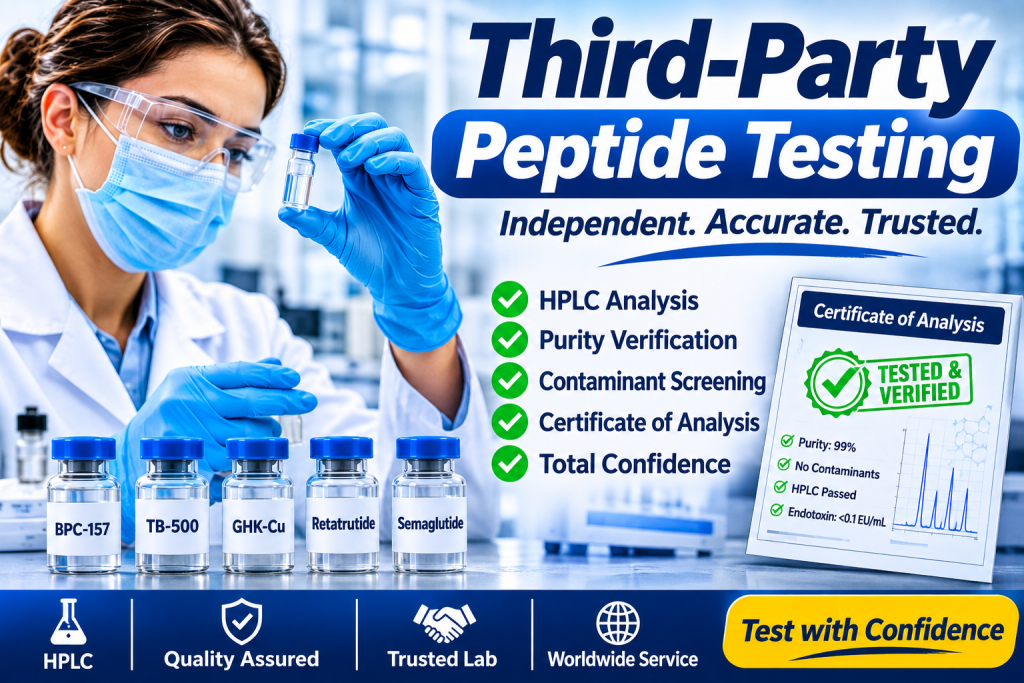
Third-party peptide testing is an independent laboratory analysis of a peptide sample performed by a facility with no financial or operational ties to the manufacturer or seller. In the United States, researchers, quality managers, and procurement teams increasingly rely on these independent reports to confirm identity, purity, and quantity before a peptide is used in a lab or research setting. This guide explains what third-party testing actually verifies, how the process works, and how to read a certificate of analysis (COA) without being misled.
The core idea is simple: a seller grading its own product is a conflict of interest. Independent verification shifts the judgment to a laboratory whose reputation depends on accuracy, which is why third-party analysis has become a baseline expectation in the peptide supply chain. If you are evaluating suppliers, understanding how this testing works helps you ask sharper questions and avoid documentation that looks official but proves very little.
What Third-Party Peptide Testing Actually Means
The term “third-party” refers to who performs the test, not which method is used. A first-party test happens in-house; a second-party test is done by the buyer or a contracted party; a third-party test is run by an uninvolved, accredited laboratory. That independence is the entire point.
Most independent peptide analysis in the U.S. is built around a few standard measures: identity confirmation, purity percentage, and the amount of peptide present. These three figures answer the most common questions buyers have—”Is this what it says it is, how clean is it, and is the quantity honest?” Testing does not, by itself, establish that a peptide is safe or legal for a given use; it documents composition and quality.
Why Independent Verification Matters in the Peptide Supply Chain
The peptide market has expanded quickly, and not every product on offer is backed by verifiable data. A label is a claim; a third-party certificate of analysis is evidence. That distinction matters when research integrity, reproducibility, or regulatory review depends on knowing exactly what is in a vial.
Independent testing also protects against honest mistakes. Even a well-run facility can ship the wrong lot, underfill a vial, or produce a batch with lower purity than intended. A third-party check catches these problems before they reach the end user, which is why reputable sellers treat outside analysis as a quality control step rather than a marketing add-on. You can read more about how a supplier approaches this on the peptide quality and sourcing resources page.
Identity, Purity, and Quantity Are Different Questions
It helps to separate the three core metrics, because they are measured differently and one does not guarantee another:
- Identity confirms the peptide’s molecular structure matches what was ordered. A sample can be highly pure and still be the wrong peptide.
- Purity reports what percentage of the detected material is the target peptide, typically by area percentage on a chromatogram. High purity with the wrong identity is still wrong.
- Quantity or content checks how much peptide is actually present, which guards against underfilled or overfilled vials.
A certificate that reports only one of these, or reports “99%” with no method or context, tells an incomplete story. A trustworthy COA addresses all three.
How the Testing Process Works Step by Step
Understanding the workflow helps you judge whether a report is credible. The process usually moves through sampling, analysis, interpretation, and documentation.
Step 1: Sampling and Chain of Custody
The sample must be traceable to a specific lot. That means recording batch numbers, shipping dates, and who handled the sample at each stage. A COA that cannot be tied back to a particular lot number is difficult to trust, because you have no way to know it reflects the product you received.
Step 2: Laboratory Analysis
An independent lab runs the analytical methods, most commonly high-performance liquid chromatography (HPLC) for purity and mass spectrometry (MS) for molecular identity. Some facilities add other tests depending on the request. The lab, not the seller, generates the raw data.
Step 3: Data Interpretation and Reporting
The lab interprets results and issues a report. Crucially, the report should include the method used, the instrument, the acceptance criteria, the date, and the analyst’s signature or lab accreditation details. These details are what let a reader verify the claim rather than take it on faith.
Step 4: Documentation and Traceability
Finally, the COA is published alongside the product so buyers can match report to lot. This is where transparency either holds up or falls apart—an unlabeled certificate floating in a product gallery is not traceable and therefore not very useful.
The Analytical Methods Behind a Certificate of Analysis
Different methods answer different questions. Knowing which test produces which number keeps you from over-reading a report. Below are the techniques most commonly encountered.
High-Performance Liquid Chromatography (HPLC)
HPLC separates the components of a sample and expresses the target peptide as a percentage of the total peak area. It is the standard method for purity. A common pitfall: a 99% purity figure reflects only the detected peaks, so it should always be read alongside identity data. The U.S. Pharmacopeia publishes general analytical chapters that describe chromatographic principles in more depth for readers who want the technical foundation.
Mass Spectrometry (MS) for Molecular Identity
Mass spectrometry measures the mass-to-charge ratio of molecules, producing a fingerprint that can confirm whether the peptide’s structure matches its expected molecular weight. This is where identity is genuinely established. When a report includes a mass spectrum with an observed mass matching the theoretical value, that is meaningful evidence—far more so than a purity percentage alone.
Other Techniques You May Encounter
Depending on the lab, you might also see amino acid analysis, water content testing, or residual solvent checks. These add useful context, but they are not substitutes for the core identity and purity data. For a broad, neutral reference on analytical chemistry concepts, the Wikipedia entry on high-performance liquid chromatography is a reasonable starting point.
How to Read a Certificate of Analysis Without Getting Fooled
A COA is a document you should be able to audit, not just admire. Use these checks to separate substantive reports from decorative ones. This is the practical heart of third-party peptide testing—the report is only as good as the details it discloses.
Red Flags to Watch For
- No lot number. If the COA cannot be linked to your specific batch, traceability is broken.
- No method named. “Purity: 99%” with no mention of HPLC or any instrument is a number without a source.
- No lab identity or accreditation. A credible report names the testing laboratory and, ideally, its accreditation body.
- Identical reports across products. Recycling the same certificate for multiple lots or peptides undermines the claim entirely.
- Missing dates and signatures. Analysis date and analyst sign-off are part of a legitimate report.
Details That Signal a Substantive Report
Look for a full header with lab name and contact details, sample identifiers, the analytical method and instrument, raw chromatogram and spectrum images, acceptance criteria, results against those criteria, and a signed conclusion. The presence of raw data—not just a summary line—is one of the strongest signs that real analysis occurred.
Third-Party Testing Versus In-House Testing and Self-Reported Claims
The difference between these three approaches is the difference between evidence and assertion. In-house testing can be excellent, but it is performed by the party with an interest in the result, so it is best treated as internal quality control rather than independent proof. Self-reported claims on a product page are marketing, not analysis.
| Approach | Who Performs It | Independence | Typical Use |
|---|---|---|---|
| Self-reported claim | Seller | None | Marketing copy |
| In-house testing | Manufacturer’s own lab | Limited | Internal quality control |
| Third-party testing | Uninvolved accredited lab | High | External verification |
None of these is meaningless, but only the third gives a buyer an outside opinion. When a supplier publishes independent results alongside internal controls, that pairing is a good sign of a mature quality process—something you can explore further through the supplier’s quality assurance approach.
What Third-Party Peptide Testing Does and Does Not Prove
Honesty about limits is part of credibility. Third-party testing proves a lot, but it does not prove everything, and overstating it invites the same skepticism that bad certificates deserve.
What It Does Establish
Independent analysis can confirm that a specific lot contains the expected peptide, that its purity meets a stated threshold, and that the quantity matches the label. It creates a documented, traceable record that supports reproducibility in research and quality review in procurement.
What It Cannot Guarantee
Testing a sample does not guarantee every vial in a production run is identical, nor does it certify safety, legality, or suitability for any particular use. A certificate reflects the sample tested, on the date tested. Results also depend on the lab’s competence and the methods chosen, which is why accreditation and method disclosure matter. No certificate should be read as a blanket endorsement beyond what the data supports.
Questions to Ask a Supplier About Their Testing Program
A short, direct conversation reveals more than a glossy product page. These questions separate suppliers who understand their own testing from those who simply post a logo.
- Which independent laboratory performs your analysis, and is it accredited?
- Can I see the full COA for the specific lot I am ordering, including raw chromatogram and spectrum?
- How often do you test—every lot, or periodically?
- What acceptance criteria do you apply for purity and identity?
- How do you handle a batch that fails testing?
- Are reports dated and signed by the testing lab?
A supplier who answers these clearly and consistently is signaling that they handle third-party peptide testing as a real process. Vague or evasive answers are just as informative.
Who Relies on Independent Peptide Analysis
The audience for this testing is broader than it might first appear. Research laboratories use it to confirm that materials match protocol requirements, because an unverified peptide can quietly invalidate months of work. Procurement and quality teams use COAs to document supplier due diligence. Educators and students use certificates to understand analytical chemistry in practice.
Across all of these groups, the underlying need is the same: a defensible record of what a sample actually contains. Third-party analysis turns a vendor’s word into something checkable, and that is valuable whether you are ordering one vial or managing a supply chain.
The Growing Role of Transparency in the U.S. Peptide Market
Buyers in the United States are becoming more sophisticated about documentation. As independent testing becomes more common, the absence of a verifiable COA stands out rather than the presence of one. That shift rewards suppliers who invest in outside analysis and publish results openly.
Transparency also raises the bar for how results are presented. A certificate buried in a product gallery with no lot traceability no longer satisfies an informed buyer. The trend is toward full reports, batch-specific data, and clear disclosure of methods—all of which make the market easier to navigate for anyone who takes quality seriously.
FAQ: Common Questions About Third-Party Peptide Testing
What is third-party peptide testing?
It is independent laboratory analysis of a peptide sample conducted by a facility with no stake in the sale. The lab confirms identity, purity, and quantity and issues a certificate of analysis documenting the methods and results. Independence is what distinguishes it from in-house testing.
How do I verify a certificate of analysis is genuine?
Check that the COA includes a lot number matching your product, the testing laboratory’s name and accreditation, the analytical method and instrument, raw chromatogram and mass spectrum images, analysis dates, and a signature. If any of these are missing, treat the report with caution and ask the supplier for a complete version.
Does third-party testing mean a peptide is safe to use?
No. Testing documents composition, purity, and quantity—it does not certify safety, legality, or suitability for any use. A certificate reflects only the sample tested on the date of analysis. Safety and regulatory status depend on many factors outside the scope of a lab report.
What does 99% purity on a COA actually mean?
Purity percentage typically reflects the target peptide’s share of the total detected peak area under a specific chromatographic method. It says nothing about identity on its own, so it should always be read alongside mass spectrometry data confirming the molecular weight matches the expected peptide.
How often should peptides be third-party tested?
Best practice is lot-by-lot testing, so each batch has its own certificate. Periodic testing of selected lots is better than nothing but leaves gaps, because a passing result for one batch does not guarantee the next. Ask your supplier which approach they follow.
Can a supplier test its own peptides and call it third-party testing?
No. If the manufacturer or seller performs or controls the analysis, the result is in-house testing, not independent verification. Third-party testing requires an uninvolved laboratory whose findings the seller cannot edit.
