
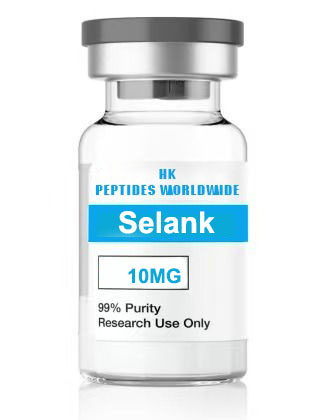
Selank 10 mg research peptide USA
Original price was: $84.00.$72.00Current price is: $72.00.
Bulk Price for 10 Vials.
Lab-grade Selank 10 mg lyophilized peptide with batch-specific COA, HPLC-verified purity of 98% or higher, and mass spectrometry identity confirmation. Ships domestically within the USA with cold-chain packaging. Strictly for research use only — not for human or veterinary consumption
Buy Selank 10 mg Research Peptide in the USA for Laboratory Study
Selank 10 mg research peptide USA buyers rely on is a synthetic peptide supplied for laboratory investigation of the tuftsin-derived compound and its effects on anxiety-related and cognitive research models. Each vial delivers 10 mg of lyophilized Selank peptide for reconstitution and controlled study. This page explains what researchers receive, how to evaluate a trustworthy supplier, and what to check before you buy Selank for sale online in the United States.
What Is Selank 10 mg Research Peptide?
Selank is a synthetic heptapeptide modeled on tuftsin, a naturally occurring immunomodulatory peptide fragment. Researchers study it in non-clinical settings for its reported interactions with GABA-related signaling, enkephalin metabolism, and stress-response pathways. The 10 mg vial size suits multi-arm study designs and repeat trials where consistent material is essential.
This product is sold strictly for research and laboratory use. It is not a drug, dietary supplement, or treatment, and it is not intended for human or veterinary consumption. U.S. researchers should confirm that their institution permits the compound and that handling follows applicable biosafety and chemical-hygiene protocols.
Key Specifications at a Glance
Transparency about specifications separates legitimate suppliers from resellers. The table below summarizes what a research-grade Selank 10 mg listing should disclose.
| Specification | What to Look For |
|---|---|
| Peptide identity | Selank (Thr-Lys-Pro-Arg-Pro-Gly-Pro), synthetic |
| Quantity | 10 mg per vial, lyophilized powder |
| Purity | 98% or higher, verified by HPLC |
| Identity confirmation | Mass spectrometry (MS) report |
| Form | Lyophilized powder requiring reconstitution |
| Storage | Store lyophilized vials frozen; protect from light |
| Documentation | Certificate of analysis (COA) per batch |
If a listing omits purity data, batch-specific COAs, or storage guidance, treat that as a warning sign. Reputable vendors publish this information before a purchase, not after.
Why Researchers Choose the 10 mg Format
The 10 mg vial balances economy and flexibility. Smaller vials force frequent reordering and introduce batch-to-batch variation into long studies. Larger formats create waste when protocols use small quantities per subject or assay. A 10 mg vial supports pilot work, dose-ranging experiments, and replication runs from a single documented lot.
Freshly reconstituted peptide also degrades over time, so matching vial size to study duration protects data quality. Researchers planning extended timelines can order research peptides with documented purity and align each vial with a defined experimental window.
How to Buy Selank Research Peptide in the USA Safely
Search interest around where to buy Selank and Selank near me reflects a crowded, uneven market. Use a short checklist to filter suppliers before you order.
Verify Documentation Before Purchase
Request the batch COA and confirm the lot number matches the vial label. The document should show an HPLC chromatogram, a purity figure, and mass spectrometry data confirming the peptide’s molecular identity. A COA without a lot number is effectively meaningless.
Confirm Domestic Fulfillment and Storage
U.S.-based shipping shortens transit time and reduces the risk of heat exposure in transit. Ask how the vendor packs the product — insulated shipping with cold packs is standard for temperature-sensitive peptides. Confirm the dispatch location rather than assuming it.
Check Handling and Labeling Standards
Research-grade vendors label products clearly as not for human use. They also provide reconstitution and storage guidance in writing. If a seller markets Selank with health claims or dosing advice for people, treat that as a red flag and look elsewhere.
Researchers comparing suppliers may also review bulk peptide options for laboratory supply to match catalog choices with institutional procurement requirements.
Understanding Selank Dosage in Research Contexts
Selank dosage questions dominate search traffic, but the honest answer is that no universal research dosage exists. Published preclinical studies have used a range of concentrations and routes that vary by model, endpoint, and study design. Researchers must derive their own parameters from peer-reviewed literature and institutional review.
Several practical steps support sound design:
- Start with the literature. Review original preclinical studies rather than summaries or vendor pages.
- Pilot small. Use dose-ranging runs before committing to a full study.
- Document everything. Record reconstitution volume, concentration, storage conditions, and handling times.
- Reconstitute carefully. Use appropriate laboratory diluents and avoid vigorous agitation, which can degrade peptides.
Vendors should not provide human dosing instructions, and responsible ones do not. If a seller offers Selank dosage guidance aimed at consumers, that is a compliance issue, not a convenience.
Purity, Testing, and What the COA Should Prove
Peptide quality hinges on synthesis standards and independent verification. High-performance liquid chromatography separates the target peptide from impurities and truncation products, while mass spectrometry confirms molecular weight. Together, these tests establish identity and purity.
Ask whether testing is performed in-house or by a third-party laboratory. Third-party analysis carries more weight because it reduces conflicts of interest. Also confirm that COAs are batch-specific, since purity varies between production runs even with the same synthesis protocol.
Storage matters as much as synthesis. Lyophilized peptide should remain frozen and protected from light; reconstituted material typically requires refrigeration and should be used within a defined window. Mishandled vials degrade regardless of the initial purity figure.
Selank in the Research Literature
Selank has drawn interest in Russian and international preclinical research, particularly around anxiolytic-like effects, learning and memory models, and immunomodulatory activity. Tuftsin-derived peptides interact with the immune and nervous systems in ways researchers continue to map. The compound’s short half-life and rapid onset are recurring themes in published work.
Researchers should read primary sources directly and note that preclinical findings do not establish safety or efficacy in humans. For peer-reviewed entry points, consult PubMed, the NIH literature database, and review the FDA’s framework for research-use-only products to understand compliance boundaries. For broader background on peptide chemistry, Wikipedia’s peptide article offers a useful orientation, though primary literature should always take precedence.
HK Peptides Worldwide: What to Expect from the Supplier
HK Peptides Worldwide supplies research peptides to laboratories and independent researchers across the United States. The catalog covers Selank 10 mg and related compounds with batch-specific documentation, clear research-use labeling, and domestic fulfillment designed to protect product integrity in transit.
Ordering follows a straightforward process: select the vial size, review the COA for the current lot, and confirm shipping and storage details at checkout. Researchers who need multiple compounds can consolidate orders to reduce handling and transit exposure. Review the full peptide catalog and ordering details to compare formats before buying.
Common Mistakes When Ordering Research Peptides
Even experienced researchers encounter avoidable problems. The most frequent ones:
- Buying on price alone. Ultra-low prices often signal unverified purity or missing documentation.
- Skipping the COA review. Always match the lot number on the certificate to the vial.
- Ignoring storage requirements. Shipping without cold packs can compromise sensitive material.
- Trusting consumer-style marketing. Health claims and human dosing advice indicate a non-research vendor.
- Ordering more than the study needs. Excess peptide may degrade before use, wasting both material and budget.
A few minutes of verification before ordering protects both the study and the budget.
Frequently Asked Questions
Is Selank 10 mg intended for human use?
No. Selank 10 mg is sold strictly for laboratory research. It is not approved for human or veterinary use, and it is not a supplement or medication.
What purity should a research-grade Selank vial have?
Look for 98% or higher purity verified by HPLC, with mass spectrometry confirming identity. Batch-specific COAs should accompany every lot.
How should Selank peptide be stored?
Store lyophilized vials frozen and protected from light. After reconstitution, follow your laboratory’s protocols and use the material within the validated window for your study.
Can I find Selank for sale near me in the United States?
Most U.S. researchers order online rather than seeking local stock. Prioritize suppliers who ship domestically, provide batch documentation, and package with cold-chain protection.
Does the supplier provide Selank dosage guidance?
Reputable research suppliers do not provide human dosing instructions. Researchers should derive parameters from peer-reviewed preclinical literature and institutional review.
What should I check before placing an order?
Confirm the lot-specific COA, purity figure, shipping method, dispatch location, and research-use labeling. Verify that the supplier’s documentation matches the product you receive.
Ordering Research-Grade Selank with Confidence
Choosing a Selank 10 mg research peptide in the USA comes down to documentation, handling, and honest labeling. Verify the COA, confirm domestic cold-chain shipping, and ignore any vendor offering consumer dosing advice. Researchers who apply that checklist can source material suited to rigorous laboratory work and keep their studies on solid footing.
Be the first to review “Selank 10 mg research peptide USA”
Related products
Research Grade Peptide
Research Grade Peptide

Research Grade Peptide

Research Grade Peptide
Research Grade Peptide
Research Grade Peptide
Research Grade Peptide
Research Grade Peptide
Reviews
There are no reviews yet.