
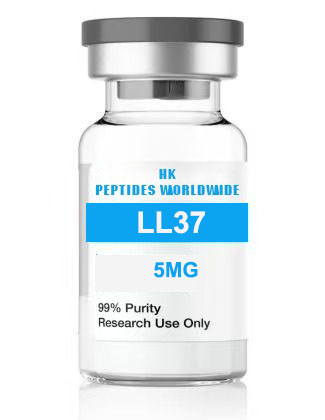
LL-37 5 mg research peptide USA
Original price was: $102.00.$90.00Current price is: $90.00.
Bulk Price for 10 vials,
LL-37 5 mg research peptide supplied lyophilized for U.S. laboratory use, with lot-specific HPLC purity and mass spectrometry documentation, clear storage guidance, and research-use-only labeling. Ideal for innate immunity, biofilm, and host-defense peptide studies
LL-37 5 mg Research Peptide USA: Product Guide for Laboratory Professionals
LL-37 is a synthetic 37-amino-acid cathelicidin peptide widely used in laboratory studies of innate immunity, biofilm disruption, and host-defense mechanisms. For U.S. research teams, an LL-37 5 mg research peptide USA option offers a practical unit size: enough material for multiple experiments without committing to bulk quantities. This guide covers what researchers should know before purchasing—how the peptide is supplied, how to verify quality, how to handle and reconstitute it, and what the published literature actually says about dosing equivalents in vitro. It is the kind of practical reference you can check before comparing research peptides from HK Peptides Worldwide against other suppliers.
What LL-37 Is and Why Researchers Use It
LL-37 is the only cathelicidin antimicrobial peptide found in humans. It is derived from the hCAP18 precursor protein and named for its 37 residues and its two leading leucine residues. Unlike many antimicrobial peptides, LL-37 works through more than one mechanism: it can disrupt microbial membranes, bind and neutralize bacterial lipopolysaccharide, and modulate immune cell signaling.
That versatility explains its popularity in bench research. Investigators use it to study membrane permeability, biofilm inhibition, wound-healing pathways, and inflammatory signaling. The peptide is also a common tool compound in studies of host-defense peptides and peptide-drug interaction work.
Because the molecule is amphipathic and positively charged, its behavior depends heavily on buffer composition, salt concentration, and pH. A peptide that performs cleanly in one assay can behave inconsistently in another—which is why source fidelity and handling matter as much as the sequence itself.
LL-37 5 mg Research Peptide USA Supply Details
The 5 mg unit is a common choice for U.S. laboratories because it suits a defined study phase without creating long-term storage burdens. Typical supply specifications look like this:
- Quantity: 5 mg of lyophilized (freeze-dried) peptide per vial
- Purity: commonly offered at ≥95% or ≥98% by HPLC
- Sequence: LLGDFFRKSKEKIGKEFKRIVQRIKDFLRNLVPRTES
- Molecular weight: approximately 4.5 kDa
- Form: white to off-white powder, pre-sterilized by filtration where stated
- Storage: −20 °C for long-term storage; protect from light and moisture
Always confirm the certificate of analysis (CoA) for the specific lot you receive. Purity percentages and salt forms (for example, trifluoroacetate versus acetate) can differ between batches, and those differences can shift results in sensitive assays.
Purity and Quality Verification
Ask three questions before you finalize any purchase. First, is HPLC purity reported at the peak area level, and if so, at what wavelength? Second, has mass spectrometry confirmed the expected molecular weight? Third, does the CoA belong to the actual lot shipped—not a generic template?
Reputable suppliers publish lot-specific documents. If a supplier cannot provide a CoA that matches your vial, treat its purity claim as unverified.
Shipping and Domestic Availability
U.S.-based researchers typically want domestic fulfillment to reduce transit time and temperature excursions. For buyers searching “LL-37 near me” or comparing sourcing options for U.S. delivery, ask about packaging (vacuum-sealed or desiccated), cold-pack use where appropriate, and dispatch schedules. Lyophilized peptide is stable at ambient temperatures for short periods, but prolonged heat exposure during summer shipping is a risk worth planning around.
How to Buy LL-37 Online Without Mistakes
When you buy LL-37 online, the transaction is straightforward—but the diligence is not. Start with the product page and verify the specifications match your planned assay. Confirm the unit size, purity grade, and salt form before adding to cart.
Next, check documentation availability. A supplier that lists a CoA, MS data, and storage instructions on the product page is typically easier to audit later. Keep the CoA filed alongside your lab records; institutional review often requires traceability.
Finally, check the supplier’s stated compliance posture. In the United States, research peptides are sold for laboratory research use only and are not intended for human or veterinary use. Suppliers should state this clearly. Buyers should also confirm that their institution’s biosafety and procurement policies permit the purchase.
Price Versus Value in Peptide Purchasing
Price per milligram is a convenient shorthand but a poor decision rule on its own. A slightly higher-price 5 mg vial with lot-specific HPLC and MS data usually beats a cheaper vial with opaque documentation, because repeating an experiment after a quality failure costs far more than the price gap.
Compare cost per milligram only among equivalent specs: same purity threshold, same salt form, same documentation standard. Otherwise you are comparing dissimilar products.
Handling, Reconstitution, and Storage
Proper handling protects both your peptide and your results. Work with lyophilized peptide at room temperature only briefly, then return the vial to −20 °C. Avoid repeated freeze-thaw cycles by aliquoting reconstituted solution into single-use volumes.
For reconstitution, sterile water or a suitable buffer is typical. Because LL-37 is positively charged, it dissolves more readily in slightly acidic or low-salt conditions than in high-salt buffers. Add solvent gently down the vial wall and swirl rather than vortex to reduce foaming and adsorption to plastic.
Peptide adsorbs to surfaces. Use low-binding tubes where possible, and consider adding a carrier protein if your assay tolerates it. Record your reconstitution date and concentration on the vial.
Understanding LL-37 Dosage in Research Contexts
Searchers often look for “LL-37 dosage,” but in a laboratory setting the term means working concentration, not a human dose. Because LL-37 is supplied for research use only, there is no approved human dosage, and none should be inferred from product listings or vendor pages.
In vitro, published studies typically report working concentrations in the low microgram-per-milliliter range, but the appropriate range depends entirely on cell type, medium composition, serum presence, and exposure time. Serum proteins can bind the peptide and reduce its effective activity, so reported concentrations from one study rarely transfer directly to another system.
Researchers should determine working concentrations empirically through pilot dilution series and cite the specific literature that informed their choice. For governing standards on laboratory chemical handling and biosafety, consult the CDC’s biosafety resources and your institution’s environmental health and safety office; for chemical hazard information, the National Institutes of Health and OSHA (osha.gov) publish relevant guidance.
Calculating a Working Solution
If you dissolve 5 mg in 1 mL of solvent, you have a 5 mg/mL stock. From there, prepare serial dilutions into your assay medium. Always label concentration, solvent, and date. A written dilution scheme in your notebook prevents the most common source of irreproducible peptide data: arithmetic drift across experiments.
Where HK Peptides Fits in a Research Supply Chain
HK Peptides Worldwide supplies research peptides with lot-level documentation and clear research-use labeling. Researchers comparing HK Peptides product listings should verify the specific LL-37 variant, purity grade, and unit size on the product page, then confirm the CoA before use.
A sensible procurement approach is to order a single 5 mg vial, run a pilot assay, and confirm performance before scaling to repeat purchases. That workflow keeps costs controlled and documentation traceable across a study.
Frequently Asked Questions
Is LL-37 5 mg research peptide USA supply intended for human use? No. Research peptides are sold for laboratory research only. They are not drugs, foods, or supplements, and they are not intended for human or veterinary administration.
What purity should I look for in an LL-37 research peptide? For most cell-based and biochemical work, ≥95% by HPLC is a common baseline, with ≥98% preferred for sensitive assays. Always confirm with lot-specific HPLC and mass spectrometry data.
How should I store a 5 mg LL-37 vial? Store lyophilized peptide at −20 °C, protected from light and moisture. After reconstitution, aliquot and freeze at −20 °C or below, and avoid repeated freeze-thaw cycles.
Can I find LL-37 near me in the United States? Domestic suppliers ship within the U.S., which shortens transit time. Search by supplier rather than location, and confirm shipping method, packaging, and dispatch timing before ordering.
What does “LL-37 dosage” mean for laboratory work? It refers to working concentration in an assay, not a human dose. Determine it empirically for your system and document the literature basis for your chosen range.
Does the salt form of LL-37 matter? Yes. Trifluoroacetate and acetate forms can behave differently in cell culture. Check the CoA and, where possible, match the salt form used in the studies you are replicating.
Be the first to review “LL-37 5 mg research peptide USA”
Related products
Research Grade Peptide
Research Grade Peptide
Research Grade Peptide
Research Grade Peptide
Research Grade Peptide
Research Grade Peptide
Research Grade Peptide

Research Grade Peptide
Reviews
There are no reviews yet.