
Uncategorized
HPLC Peptide Analysis: How to Choose the Right Testing and Supply Partner
Nov
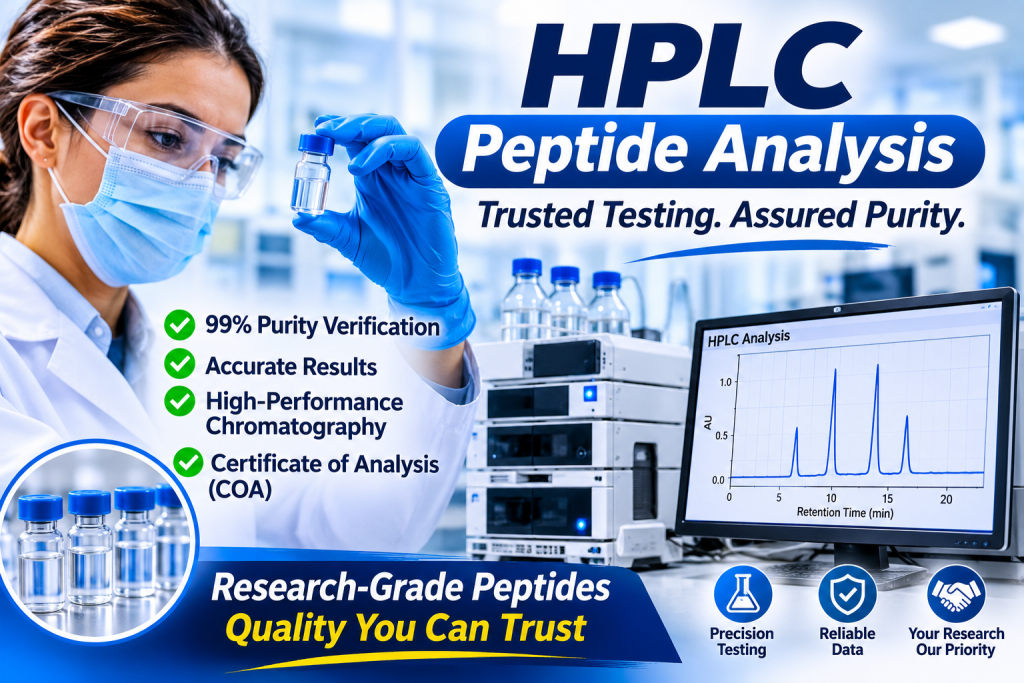
HPLC peptide analysis is the analytical backbone of modern peptide work. Whether you are a research lab qualifying a new batch of material or a buyer who needs third-party proof of purity, high-performance liquid chromatography (HPLC) is the method most people rely on to separate, identify, and quantify peptides. This guide explains what HPLC testing actually measures, how to read a chromatogram, and what to look for when you buy peptides from a US-facing supplier that provides documented HPLC results. If you are sourcing material and want to review available testing documentation, start with the peptide products and analysis resources at HK Peptides Worldwide.
The short answer for buyers: a credible peptide supplier should give you a batch-specific HPLC chromatogram, not a generic certificate. The chromatogram shows the retention time, peak purity, and any impurities present. Without it, you are relying on a label rather than evidence.
What HPLC Peptide Analysis Actually Measures
HPLC separates the components of a peptide sample by passing a dissolved sample through a column packed with a stationary phase. Because different molecules interact with that phase differently, they travel at different speeds and elute at different times. A detector, usually a UV detector at 214 or 220 nanometers for peptides, records each eluting compound as a peak.
For peptide buyers, the key outputs are straightforward:
- Purity percentage, calculated from the area of the main peak relative to total peak area.
- Retention time, which helps confirm the peptide’s identity when compared with a reference standard.
- Impurity profile, showing related peptides, truncation products, or residual solvents.
- Chromatographic conditions, meaning the column type, mobile phase, gradient, and flow rate used.
Those last details matter more than many buyers realize. A purity figure without stated conditions is difficult to verify or reproduce. A well-documented report lets an independent lab repeat the run and compare results.
Reverse-Phase HPLC: The Standard for Peptides
Reverse-phase HPLC (RP-HPLC) is the most common technique for peptide analysis. It uses a nonpolar stationary phase, typically C18 silica, and a polar mobile phase of water with acetonitrile and a small amount of acid such as trifluoroacetic acid. Peptides bind to the column based on their hydrophobicity and elute as the organic content of the mobile phase increases.
RP-HPLC works well for most synthetic peptides because small changes in sequence, such as a missing amino acid or an oxidized residue, usually shift the retention time. That sensitivity is why RP-HPLC is the default purity test in peptide quality control.
Other HPLC Modes Used for Peptides
Some analyses call for different modes. Ion-exchange HPLC separates peptides by charge and can be useful for closely related sequences. Size-exclusion chromatography (SEC-HPLC) detects aggregation in larger peptides. Hydrophilic interaction chromatography (HILIC) helps with very polar peptides that retain poorly on C18. Each mode answers a different question, and a thorough supplier will tell you which one was used.
Reading an HPLC Chromatogram Without a Chemistry Degree
A chromatogram is a graph of detector signal against time. The main peptide appears as a large peak; everything else is an impurity or an artifact of the solvent front. Here is how to interpret the essentials.
Peak purity. A purity value of 98 percent means that 98 percent of the detected UV-absorbing material eluted in the main peak. It does not guarantee the peptide is chemically perfect, but it is a reasonable indicator of batch consistency.
Shoulders and split peaks. A shoulder on the main peak often signals a closely related impurity that the method barely resolved. A split peak can indicate two forms of the peptide or a method that needs optimization.
The solvent front. The first sharp rise near the beginning of the run is usually unretained material and should not be counted as product.
Integration settings. Purity depends on how the software drew the baseline. A supplier can inflate a purity number by setting baseline thresholds aggressively. Compare reported purity with the visual appearance of the chromatogram whenever you can.
For a deeper evaluation, request the raw data file or at least a high-resolution image of the full report. A supplier with nothing to hide will provide both.
What a Real Certificate of Analysis Should Include
A certificate of analysis (CoA) is only as useful as its detail. When you evaluate peptide suppliers, check that each CoA contains the following.
- Batch or lot number that matches the vial label exactly.
- Peptide name and sequence, plus molecular weight.
- HPLC method summary, including column, mobile phase, gradient, wavelength, and flow rate.
- Chromatogram image with retention time and integrated peak table.
- Mass spectrometry confirmation, usually electrospray ionization (ESI-MS) or matrix-assisted laser desorption/ionization (MALDI-TOF), verifying the molecular weight.
- Test date and testing laboratory, whether in-house or independent.
- Storage and handling guidance for the specific peptide.
Mass spectrometry and HPLC are complementary. HPLC tells you how pure the sample is; mass spectrometry tells you whether the main peak is actually the peptide you ordered. A CoA with one but not the other is incomplete.
Independent third-party testing adds another layer of assurance, because it removes the incentive for an in-house lab to report favorable numbers. If a supplier offers third-party verification, ask which laboratory performed it.
Why HPLC Data Matters for US Buyers
The United States research supply market is competitive, and labeling standards vary. Buyers searching for research-grade peptides encounter a wide range of documentation quality. HPLC data is the most practical way to compare suppliers on something other than price.
Purity directly affects experimental outcomes. A peptide that is 95 percent pure contains 5 percent unknown material, which can confound assays, produce false positives, or reduce reproducibility. For cell culture work and receptor binding studies, that margin matters. Research institutions and contract labs generally expect documented purity before material enters a study.
Buyers should also confirm that the supplier ships domestically or has transparent shipping and customs practices. Cold-chain handling matters for peptides that are sensitive to temperature, and lyophilized powders still need protection from moisture and heat in transit. A supplier that publishes clear storage guidance alongside its analytical data is easier to work with long term. You can review storage and handling guidance for peptide research materials on the supplier’s site before ordering.
Choosing a Peptide Supplier: An HPLC-Focused Checklist
Use this checklist when comparing vendors. It applies whether you are ordering a single vial for a pilot study or a larger batch for a recurring protocol.
- Batch-specific chromatograms. Generic or representative CoAs are a red flag.
- Full method disclosure. Column chemistry, gradient, and detection wavelength should be stated.
- Mass spectrometry confirmation. Molecular weight should match the sequence.
- Retention time reported. Useful for identity confirmation against a standard.
- Third-party testing option. Independent verification reduces conflict of interest.
- Clear impurity reporting. Total purity plus notable related substances.
- Responsive technical support. Someone should be able to explain the data, not just send a PDF.
- Consistent documentation format. Easier to archive and compare across batches.
- Domestic shipping transparency. Tracking, packaging, and temperature control explained.
- Published handling instructions. Reconstitution, storage temperature, and stability guidance.
If a supplier cannot answer basic questions about its HPLC method, treat that as a signal. Documentation quality tends to track operational quality.
Common HPLC Problems and What They Tell You
Not every unusual chromatogram means a bad batch. Sometimes the method, not the peptide, is the issue. Knowing the difference helps you ask better questions.
Broad or tailing peaks. Often caused by column overload, secondary interactions, or a poorly optimized gradient. Ask whether the sample was re-run at a lower load.
Low recovery. Some hydrophobic peptides stick to the column or precipitate in the injection solvent. A different organic content in the sample diluent can resolve this.
Unexpected early peaks. These may be counterions, residual trifluoroacetic acid, or small fragments. Their identity should be explained in the CoA.
Drifting baseline. Usually a gradient or detector equilibration issue rather than a sample problem, but it makes integration less reliable.
Inconsistent purity across batches. This points to synthesis or purification variability. A supplier should be able to explain batch-to-batch differences and provide data for the specific lot you receive.
A supplier who can discuss these issues intelligently is more useful than one who simply quotes a high purity number.
HPLC in the Broader Peptide Quality Picture
HPLC is essential but not sufficient on its own. A complete quality picture usually includes several techniques working together.
Mass spectrometry confirms molecular identity and detects sequence errors that HPLC might miss.
Amino acid analysis verifies composition and can quantify peptide content versus counterion mass.
Karl Fischer titration measures water content, which affects how much actual peptide is in each vial.
Elemental analysis or ion chromatography quantifies counterions such as acetate or trifluoroacetate.
Endotoxin testing matters for any material intended for cell-based work.
For most buyers, a CoA combining HPLC purity and mass spectrometry confirmation covers the essentials. Labs with stricter requirements may request additional testing, and a good supplier will accommodate reasonable requests or point you to a testing lab.
Frequently Asked Questions About HPLC Peptide Analysis
What purity level should I expect from research-grade peptides?
Many research suppliers report purities of 95 percent or higher, and some offer 98 percent or greater for sensitive applications. The right threshold depends on your assay. Always verify the reported figure against the chromatogram rather than the marketing copy.
Can HPLC confirm which peptide I received?
HPLC alone cannot fully confirm identity. Retention time comparison with a reference standard helps, but mass spectrometry is the definitive check. Look for both on the CoA.
Why do two suppliers report different purities for the same peptide?
Different methods produce different numbers. Column chemistry, gradient slope, detection wavelength, and integration settings all affect the result. Purity figures are only comparable when the methods are comparable.
Is a generic certificate of analysis acceptable?
No. A CoA should be tied to the specific lot number on your vial. Generic documents cannot tell you anything about the material in your hands.
How should peptides be stored after receipt?
Most lyophilized peptides should be stored frozen and protected from light and moisture, with reconstituted solutions kept cold and used within a defined window. Follow the specific guidance on your CoA, since stability varies by sequence.
Does HPLC testing add cost or delay to an order?
It can add both, but documented testing is part of the product rather than an extra. Treat analytical documentation as a standard expectation when comparing suppliers in the US market.
Final Takeaways for Peptide Buyers
HPLC peptide analysis gives you a verifiable picture of purity, and it is the single most useful document in a peptide purchase. Request batch-specific chromatograms, confirm that mass spectrometry accompanies the HPLC data, and read the method details before you trust a percentage. Suppliers that publish thorough documentation make your reproducibility problems easier to solve. If you are ready to compare material with full analytical support, review the HPLC-documented peptide catalog at HK Peptides Worldwide and check the certificate details for the specific batch you plan to order.
For reference material on chromatographic methods, the United States Pharmacopeia publishes general chapters on chromatography, and the National Institutes of Health provides research guidance relevant to laboratory quality practices. The Internet Archive also hosts archived analytical chemistry texts useful for method background.
