
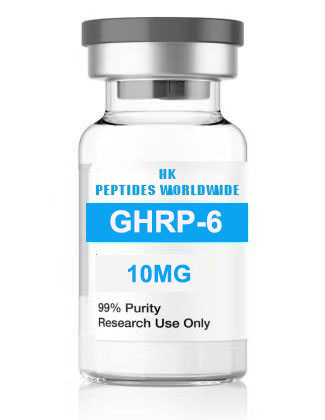
GHRP-6 Acetate 10 mg research peptide USA
Original price was: $61.00.$54.00Current price is: $54.00.
Bulk Price for 10 vials.
GHRP-6 Acetate 10 mg is a research-grade lyophilized peptide for GHS-R1a signaling, growth hormone, and metabolic studies. Supplied with lot-specific purity documentation for laboratory use only.
GHRP-6 Acetate 10 mg Research Peptide USA: A Complete Laboratory Guide
GHRP-6 Acetate 10 mg research peptide USA laboratories rely on is a synthetic hexapeptide supplied as a lyophilized powder for controlled in-vitro and preclinical study. Each vial contains 10 mg of the acetate salt, a format that supports reconstitution into precise working concentrations for receptor-binding assays, cell-signaling experiments, and metabolic research models. This guide explains what the compound is, how researchers handle it, what the published literature reports, and what to check before you source a qualified research peptide supplier.
GHRP-6, or growth hormone-releasing peptide-6, belongs to the growth hormone secretagogue family. It was developed in the 1980s as a synthetic analog of the endogenous peptide ghrelin’s active core, and it remains one of the most studied secretagogues in endocrine and appetite research. Understanding its structure, mechanism, and practical handling helps laboratory teams design cleaner experiments.
What Is GHRP-6 Acetate?
GHRP-6 is a six-amino-acid peptide with the sequence His-D-Trp-Ala-Trp-D-Phe-Lys-NH2. The acetate salt form improves stability and solubility during lyophilization, which is why most research-grade vials ship as an acetate powder rather than a free base.
The peptide binds the growth hormone secretagogue receptor, commonly called GHS-R1a, a G-protein-coupled receptor found in the pituitary and hypothalamus. Activation of this receptor triggers calcium signaling and downstream growth hormone release in model systems. Researchers also study GHRP-6 Acetate 10 mg opioid receptor research peptide USA applications, because early work noted weak binding to opioid receptor subtypes, though this activity is modest and often secondary to GHS-R1a effects. Learn more about the role of ghrelin and GHS-R1a signaling in endocrine regulation before designing receptor-specific protocols.
Key Specifications at a Glance
- Compound: GHRP-6 Acetate (growth hormone-releasing peptide-6 acetate)
- Sequence: His-D-Trp-Ala-Trp-D-Phe-Lys-NH2
- Molecular weight: approximately 873 g/mol (acetate salt)
- Vial content: 10 mg lyophilized powder
- Appearance: white to off-white powder or cake
- Purity: typically 98% or higher by HPLC for research grade
- Storage: store lyophilized vials at -20°C, protected from light and moisture
These figures are standard reference values. Always confirm the certificate of analysis for the specific lot you receive.
How GHRP-6 Works in Research Models
The primary mechanism studied is GHS-R1a activation. When GHRP-6 binds the receptor, phospholipase C signaling increases intracellular calcium, which drives growth hormone release from somatotroph cells in pituitary preparations. This pathway is distinct from growth hormone-releasing hormone signaling, which is why the two are often compared in the literature.
Secondary mechanisms include appetite-related signaling in hypothalamic circuits and mild interaction with opioid receptor pathways. Researchers investigating the GHRP-6 acetate 10 mg opioid receptor research peptide USA context should note that reported opioid affinity is low, so dose-response curves and receptor selectivity controls matter. Including a GHS-R1a antagonist as a negative control strengthens mechanistic conclusions.
Growth Hormone Secretion Research
Much of the foundational data comes from animal and cell-culture work. In these models, GHRP-6 stimulates pulsatile growth hormone release and can influence insulin-like growth factor-1 levels over time. Researchers typically examine dose-response relationships, timing of administration relative to sampling, and interaction with other secretagogues. Results from animal models do not automatically translate to human physiology, so avoid overgeneralizing.
Appetite and Metabolic Studies
GHRP-6 has been associated with increased food intake in several animal studies, likely through hypothalamic signaling related to ghrelin pathways. Metabolic researchers use it to probe energy balance, body composition, and feeding behavior. These endpoints require careful controls for stress, housing conditions, and baseline body weight, because feeding behavior is sensitive to many variables.
Handling and Reconstitution Best Practices
Proper technique protects both the peptide and the integrity of your data. Work in a clean, temperature-controlled environment and use aseptic technique throughout.
Step-by-Step Reconstitution
- Equilibrate the vial to room temperature before opening.
- Use a suitable solvent, such as sterile bacteriostatic water or the buffer specified in your protocol.
- Add the solvent slowly down the vial wall rather than directly onto the powder cake.
- Swirl gently; never vortex or shake vigorously, as this can denature the peptide.
- Allow full dissolution and inspect for particulates before use.
General GHRP-6 Acetate Dosage Considerations for Researchers
There is no universal GHRP-6 Acetate dosage that applies across experiments. Dosing depends entirely on your model, route, species, and research question. Researchers should source doses from peer-reviewed protocols rather than marketing material, document every concentration calculation, and prepare fresh working solutions where stability data support it. For guidance on general laboratory peptide handling, the U.S. Pharmacopeia peptide resources offer useful standards.
Storage After Reconstitution
Reconstituted peptides are less stable than lyophilized powder. Most protocols recommend refrigerating working solutions at 2–8°C for short-term use, avoiding repeated freeze-thaw cycles, and protecting solutions from light. Aliquot larger volumes before freezing to preserve integrity.
Buying GHRP-6 Acetate in the United States
Whether you are ready to buy GHRP-6 Acetate online or comparing domestic options, quality verification should come before price. A credible vendor provides a lot-specific certificate of analysis with HPLC purity data and mass spectrometry confirmation, alongside clear handling instructions and batch traceability.
Researchers frequently search for GHRP-6 Acetate for sale and ask where to buy GHRP-6 Acetate or look for GHRP-6 Acetate near me when they need fast domestic shipping. In practice, domestic fulfillment shortens transit time and reduces temperature excursions during shipping, both of which matter for peptide integrity. Still, verify documentation before ordering, and confirm that the supplier serves the research market only.
Questions to Ask Before You Purchase
- Does the vendor publish third-party purity testing?
- Is the certificate of analysis specific to the lot number on your vial?
- Are storage and shipping conditions clearly documented?
- Does the supplier restrict sales to qualified research buyers?
- Are reshipping and cold-chain policies transparent?
What to Expect from a Quality Supplier
A reliable supplier ships lyophilized powder in sealed, properly labeled vials, often with cold packs when temperatures require it. Labeling should include compound name, quantity, lot number, and storage guidance. Review the U.S. FDA guidance on research use and your institution’s compliance policies to confirm your intended use falls within permitted boundaries. Vetted sources like HK Peptides Worldwide structure their catalog around research-only compounds with batch documentation.
Common Research Pitfalls to Avoid
Inconsistent results often trace back to handling errors rather than the compound itself. Overly vigorous mixing, improper storage, and undocumented reconstitution volumes introduce avoidable variability.
Another frequent issue is treating literature doses as universal. Species, route, and endpoint all change effective concentrations, so calibrate from your own pilot data. Finally, failing to include receptor-specific controls can lead researchers to overstate secondary mechanisms such as opioid pathway involvement.
FAQ
What is GHRP-6 Acetate 10 mg used for in research? It is used in preclinical and in-vitro studies of growth hormone secretion, GHS-R1a receptor signaling, appetite regulation, and metabolic endpoints.
How should GHRP-6 Acetate be stored? Store lyophilized vials at -20°C, protected from light and moisture. Refrigerate reconstituted solutions at 2–8°C and avoid repeated freeze-thaw cycles.
Is there a standard GHRP-6 Acetate dosage? No. There is no universal dosage; researchers should derive concentrations from peer-reviewed protocols matched to their model, route, and experimental question.
Does GHRP-6 interact with opioid receptors? Reported opioid receptor activity is low compared with GHS-R1a binding. Any opioid-related investigation should include selective controls to confirm mechanism.
Is GHRP-6 approved for human use? No. Research peptides are supplied for laboratory and preclinical research only and are not approved medicines. Confirm compliance with all applicable regulations.
What purity should I expect from research-grade GHRP-6 Acetate? Reputable suppliers typically provide 98% or higher purity by HPLC, confirmed on a lot-specific certificate of analysis.
Be the first to review “GHRP-6 Acetate 10 mg research peptide USA”
Related products
Research Grade Peptide
Research Grade Peptide
Research Grade Peptide
Research Grade Peptide
Research Grade Peptide
Research Grade Peptide
Research Grade Peptide
Research Grade Peptide
Reviews
There are no reviews yet.