
Uncategorized
Lipo C With B12: Understanding the Ingredients and Their Role in Research
Aug
Introduction: What Is Lipo C With B12?
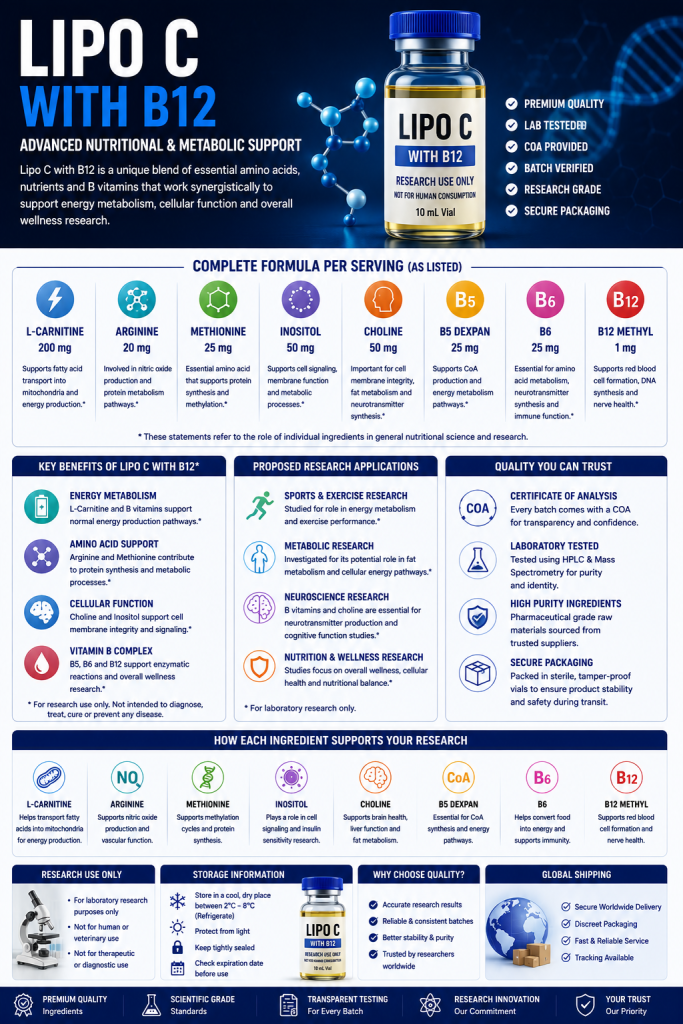
Lipo C with B12 is a combination formulation that brings together several nutrients and amino-acid-related compounds that are commonly discussed in metabolic and nutritional research.
Formulations marketed under names such as “Lipo C” or “Lipo C with B12” are not necessarily standardized. Ingredients, concentrations, manufacturing processes, and intended uses can differ between suppliers and compounded products. For this reason, researchers and buyers should always examine the exact product specification rather than assuming that every Lipo C formulation is identical.
The formulation discussed in this article contains:
- L-Carnitine: 200 mg
- Arginine: 20 mg
- Methionine: 25 mg
- Inositol: 50 mg
- Choline: 50 mg
- B5, Dexpanthenol: 25 mg
- B6: 25 mg
- Methyl B12: 1 mg
The values above describe the formulation provided for this article. They should not be interpreted as a recommended dose or administration schedule.
This guide looks at the individual ingredients, their biological roles, quality considerations, and the importance of accurate product documentation.
Lipo C With B12 Ingredient Profile
L-Carnitine: 200 mg
L-carnitine is a naturally occurring compound involved in cellular energy metabolism. It plays a role in transporting long-chain fatty acids into mitochondria, where fatty-acid oxidation takes place.
Because of its involvement in energy metabolism, L-carnitine is frequently studied in nutritional and metabolic science.
Research involving L-carnitine includes areas such as:
- Cellular energy metabolism
- Fatty-acid transport
- Mitochondrial biology
- Nutritional science
- Exercise physiology
Its presence in Lipo C formulations is one reason these products are frequently associated with metabolic research.
Arginine: 20 mg
Arginine is an amino acid involved in several biological pathways.
Researchers study arginine in relation to:
- Nitric oxide biology
- Amino-acid metabolism
- Protein metabolism
- Cellular signaling
- Vascular biology
The amount of arginine in a particular formulation should always be verified from the product label or current certificate of analysis.
Methionine: 25 mg
Methionine is an essential amino acid that participates in protein synthesis and methylation-related biochemical pathways.
Research involving methionine includes:
- Protein metabolism
- Methylation pathways
- Amino-acid metabolism
- Cellular biology
- Nutritional science
Methionine is also connected to the broader methionine cycle, which is important in cellular biochemical processes.
Inositol: 50 mg
Inositol is a naturally occurring carbohydrate-like compound that participates in cellular signaling.
Scientists study inositol and related compounds in areas including:
- Cell signaling
- Membrane biology
- Phosphatidylinositol pathways
- Metabolic research
- Cellular communication
Its biological functions make it an interesting component of combination nutritional formulations.
Choline: 50 mg
Choline is an essential nutrient involved in several biological processes.
It contributes to the production of phosphatidylcholine and acetylcholine and participates in lipid metabolism and cellular membrane structure.
Research involving choline includes:
- Lipid metabolism
- Cell membrane biology
- Neurobiology
- Nutritional science
- Metabolic research
B Vitamins in Lipo C With B12
B5, Dexpanthenol: 25 mg
Dexpanthenol is a form related to vitamin B5 and is converted within biological systems to pantothenic acid.
Vitamin B5 is involved in coenzyme A metabolism, which is important for numerous biochemical reactions.
Research into B5-related pathways includes:
- Energy metabolism
- Fatty-acid metabolism
- Cellular biochemical pathways
- Coenzyme biology
Vitamin B6: 25 mg
Vitamin B6 refers to a group of related compounds involved in numerous enzymatic reactions.
Vitamin B6-dependent pathways are associated with:
- Amino-acid metabolism
- Neurotransmitter synthesis
- Protein metabolism
- Cellular enzymatic activity
Because vitamin B6 participates in many biochemical reactions, it remains an important subject in nutritional and metabolic research.
Methyl B12: 1 mg
Methylcobalamin, commonly called methyl B12, is one of the biologically active forms of vitamin B12.
Vitamin B12 is involved in important biochemical pathways, including:
- DNA synthesis
- Red blood cell formation
- Neurological function
- Methylation reactions
- Cellular metabolism
Methyl B12 is therefore frequently discussed in nutritional and biochemical research.
How the Ingredients Relate to Metabolic Research
Energy Metabolism
Several components of this formulation are involved in biochemical pathways related to energy production.
L-carnitine, vitamin B5, vitamin B6, and vitamin B12 each participate in different aspects of cellular metabolism.
However, the presence of these ingredients in a formulation does not automatically establish that the complete combination produces a particular clinical effect.
Amino-Acid Metabolism
Arginine and methionine are amino acids involved in different metabolic pathways.
Researchers study these compounds individually to understand:
- Protein metabolism
- Nitrogen metabolism
- Cellular signaling
- Methylation pathways
Combination formulations can provide an interesting subject for laboratory research, but each ingredient should still be evaluated independently.
Cellular Signaling
Inositol and choline are particularly relevant to research involving cellular membranes and signaling pathways.
Understanding these pathways helps scientists investigate how cells communicate and respond to their environment.
Why Accurate Formulation Information Matters
Not All Lipo C Products Are the Same
One of the most important considerations when researching Lipo C products is that the name itself does not guarantee a standardized formulation.
Different products may contain different:
- Ingredients
- Concentrations
- Forms of vitamins
- Manufacturing processes
- Excipients
- Quality-control procedures
Researchers should therefore compare the complete formulation rather than relying on the product name alone.
Check the Label
A complete product specification should clearly identify each ingredient and its amount.
For the formulation discussed in this article, the listed amounts are:
| Ingredient | Listed Amount |
|---|---|
| L-Carnitine | 200 mg |
| Arginine | 20 mg |
| Methionine | 25 mg |
| Inositol | 50 mg |
| Choline | 50 mg |
| Dexpanthenol, B5 | 25 mg |
| Vitamin B6 | 25 mg |
| Methyl B12 | 1 mg |
Always verify the current product documentation because formulations can change.
Lipo C With B12 and Product Quality
Certificate of Analysis
A Certificate of Analysis, or COA, can provide useful information about the testing performed on a particular product or batch.
Researchers should look for documentation identifying:
- Product name
- Batch number
- Testing laboratory
- Analytical methods
- Test results
- Testing date
Read our related article on COA Tested Peptides.
Supplier Transparency
Transparent product information is particularly important for combination formulations.
A professional supplier should clearly communicate:
- Complete ingredient lists
- Concentrations
- Product specifications
- Quality-control information
- Research-use status
- Storage information where applicable
Learn more about Supplier Transparency.
Safety and Responsible Research
Research Use Only
Products marketed as research materials should be used only within appropriate laboratory research settings and according to applicable institutional requirements.
Research information should not be interpreted as medical advice or as instructions for self-administration.
Avoid Assuming That More Is Better
The concentration of an ingredient does not by itself establish that a product is more effective or appropriate.
Researchers should evaluate a formulation according to the specific purpose of their study and relevant scientific evidence.
Professional Product Documentation
Good documentation helps researchers maintain accurate records and evaluate materials objectively.
Important documents may include:
- Product specifications
- COAs
- Batch records
- Analytical testing reports
- Storage information
Current Research Interest in Nutritional Formulations
Metabolic Science
Metabolic research continues to expand as scientists investigate how nutrients, amino acids, vitamins, and cellular signaling molecules interact.
Combination formulations containing compounds such as L-carnitine, choline, inositol, and B vitamins provide opportunities for studying interactions between different biochemical pathways.
Mitochondrial Research
Mitochondria are central to cellular energy metabolism.
L-carnitine is particularly relevant to mitochondrial research because of its role in fatty-acid transport.
Scientists continue investigating how mitochondrial function relates to metabolism, aging, exercise physiology, and cellular health.
Vitamin and Nutrient Research
B vitamins remain important subjects in nutritional science because they participate in numerous enzymatic reactions.
Research continues to examine how deficiencies, metabolism, and nutrient interactions influence biological systems.
What to Look for When Comparing Lipo C Products
Before selecting a product for an appropriate research purpose, consider:
Complete Ingredient List
Can every ingredient and concentration be clearly identified?
Batch Information
Is there a specific batch or lot number?
Quality Documentation
Are appropriate laboratory testing documents available?
Supplier Transparency
Does the supplier clearly explain what the product contains?
Clear Research Status
Is the product appropriately identified as a research material rather than an approved medication?
Consistent Specifications
Can the formulation be verified against the supplied documentation?
These factors provide a better basis for comparison than marketing claims alone.
The Future of Lipo C and Metabolic Research
Research into metabolic compounds continues to benefit from advances in biotechnology, analytical chemistry, and molecular biology.
Future research may increasingly examine:
- Mitochondrial metabolism
- Nutrient interactions
- Cellular energy pathways
- Amino-acid metabolism
- Vitamin-dependent biochemical reactions
- Personalized nutritional research
Advanced laboratory technologies may also make it easier to study complex combinations of nutritional compounds at the molecular level.
Conclusion
Lipo C with B12 is a combination formulation containing several compounds associated with nutritional and metabolic biology. The formulation discussed here includes L-carnitine, arginine, methionine, inositol, choline, dexpanthenol, vitamin B6, and methyl B12.
Each ingredient has its own biological role, and researchers continue studying these compounds across areas such as cellular metabolism, amino-acid biology, mitochondrial function, nutrient science, and biochemical signaling.
Because Lipo C formulations can vary between products, accurate labeling, batch documentation, laboratory testing, and supplier transparency are essential when evaluating product quality.
For research purposes, the most important approach is to focus on verified formulation information and appropriate scientific documentation rather than relying solely on product names or promotional claims.
Frequently Asked Questions
What is Lipo C with B12?
Lipo C with B12 is a combination formulation containing several nutrients and metabolic compounds, commonly including L-carnitine, amino acids, choline, inositol, and B vitamins.
What ingredients are in this Lipo C formulation?
The formulation discussed in this article contains L-carnitine, arginine, methionine, inositol, choline, dexpanthenol, vitamin B6, and methyl B12.
Is every Lipo C formulation the same?
No. Formulations can vary between manufacturers and products, so the complete ingredient list and concentrations should always be checked.
What is methyl B12?
Methyl B12, or methylcobalamin, is one of the biologically active forms of vitamin B12 and is involved in several important biochemical pathways.
Why is L-carnitine included in metabolic research?
L-carnitine participates in the transport of long-chain fatty acids into mitochondria and is therefore widely studied in cellular energy metabolism.
Why is a COA important?
A Certificate of Analysis can provide batch-specific information about testing and product characteristics, helping researchers evaluate the material they are studying.
Is this article providing a dosing or administration routine?
No. The listed quantities describe the formulation supplied for this article and are not recommendations for dosing or administration. Any administration of a product should be determined by qualified professionals according to applicable regulations and product-specific requirements.
