
Uncategorized
KPV Peptide Research: Scientific Applications, Current Studies, and Future Potential
Aug
Introduction: Why KPV Peptide Research Is Growing
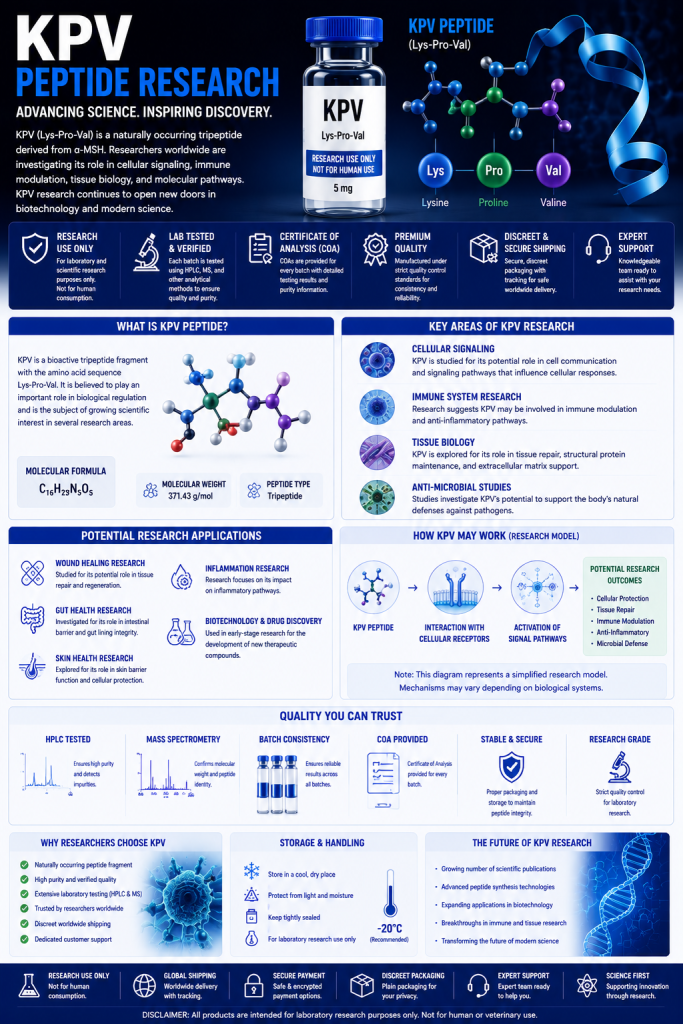
KPV peptide has become an increasingly important subject in modern biotechnology and molecular biology. As scientific understanding of peptide signaling expands, researchers continue investigating KPV for its role in cellular communication, tissue biology, and immune-related research.
Originally identified as a naturally occurring tripeptide fragment derived from alpha-melanocyte-stimulating hormone (α-MSH), KPV has attracted attention because of its unique biological properties. Researchers are exploring how this small peptide interacts with cellular pathways and contributes to a better understanding of biological regulation.
In laboratories across North America, Europe, and Asia, KPV peptide research is helping scientists investigate cellular responses, tissue biology, and molecular signaling. With advances in peptide synthesis and analytical testing, high-quality KPV peptides are becoming increasingly available for scientific research.
This guide explores KPV peptide research, its scientific applications, laboratory quality standards, and why it continues to be a growing area of biotechnology.
What Is KPV Peptide?
Understanding KPV
KPV is a short peptide consisting of three amino acids:
- Lysine (K)
- Proline (P)
- Valine (V)
Despite its small size, KPV has become widely studied because researchers believe it plays an important role in biological signaling and cellular communication.
Scientists continue investigating KPV using advanced molecular biology techniques to better understand its interactions within biological systems
Why Researchers Study KPV
Cellular Signaling Research
One of the primary reasons scientists investigate KPV is its involvement in cellular signaling.
Current laboratory studies focus on understanding how KPV may influence communication between cells involved in biological regulation and tissue maintenance.
Understanding these signaling pathways helps researchers gain deeper insights into normal cellular function.
Immune System Research
KPV has also attracted attention in studies examining immune-related biological pathways.
Researchers investigate its interaction with:
- Cellular signaling
- Biological communication
- Tissue responses
- Molecular regulation
These studies aim to improve scientific understanding of complex immune-related processes.
Tissue Biology Research
Another major area of KPV research involves tissue biology.
Scientists investigate how KPV interacts with:
- Structural proteins
- Cellular organization
- Tissue maintenance
- Extracellular matrix biology
This work contributes to broader knowledge of tissue function and molecular regulation.
Scientific Applications of KPV Peptide
Molecular Biology
Modern molecular biology uses KPV to study:
- Protein interactions
- Cellular communication
- Gene regulation
- Biological signaling
These studies continue expanding scientific knowledge.
Biotechnology
Biotechnology laboratories investigate KPV because it provides opportunities to study highly specific biological pathways.
Research areas include:
- Cellular biology
- Biomaterials
- Molecular engineering
- Biological systems
Laboratory Cell Studies
Researchers use KPV in laboratory investigations involving:
- Cell culture models
- Biological pathway analysis
- Cellular communication
- Protein signaling
Controlled laboratory environments allow scientists to explore these interactions with precision.
Importance of High-Quality KPV Peptides
Why Purity Matters
Reliable scientific research depends on peptide quality.
Researchers often select products that offer:
- High purity
- Batch consistency
- Verified analytical testing
- Comprehensive documentation
High-quality peptides help improve research reproducibility.
Certificates of Analysis (COAs)
A Certificate of Analysis helps verify peptide quality.
Researchers commonly review:
- Purity percentage
- Batch number
- Product identity
- Testing methods
- Laboratory results
Learn more in our article on COA Tested Peptides.
HPLC Testing
High-Performance Liquid Chromatography (HPLC) is commonly used to verify:
- Product purity
- Batch consistency
- Impurity levels
This analytical technique remains one of the industry’s quality standards.
Mass Spectrometry
Mass Spectrometry provides additional verification by confirming:
- Molecular weight
- Product identity
- Peptide integrity
Researchers often rely on both HPLC and MS for quality assurance.
Choosing Reliable KPV Research Peptides
Supplier Transparency
Professional suppliers often provide:
- Certificates of Analysis
- HPLC reports
- Batch documentation
- Storage recommendations
- Product specifications
Transparency helps researchers evaluate product quality before purchasing.
Read our guide on Supplier Transparency.
Manufacturing Standards
Reliable peptide manufacturers prioritize:
- Quality control
- Manufacturing consistency
- Accurate synthesis
- Laboratory verification
These standards contribute to dependable research materials.
Customer Support
Researchers appreciate suppliers that offer:
- Technical guidance
- Fast communication
- Order tracking
- Educational resources
Strong customer support improves the purchasing experience.
Technology Driving KPV Research
Artificial Intelligence
AI is increasingly used in peptide research to:
- Analyze biological data
- Predict molecular interactions
- Improve experimental design
- Support peptide discovery
Artificial intelligence is accelerating innovation throughout biotechnology.
Advanced Peptide Synthesis
Modern synthesis technologies continue improving:
- Purity levels
- Sequence accuracy
- Batch consistency
- Manufacturing efficiency
These advances help produce more reliable research peptides.
Future Trends in KPV Peptide Research
Expanding Scientific Interest
KPV research continues expanding as scientists explore new applications in molecular biology, biotechnology, and tissue science.
Future research is expected to focus on:
- Cellular signaling
- Biological regulation
- Advanced molecular pathways
- Innovative laboratory technologies
Higher Quality Standards
The peptide industry continues moving toward greater transparency through:
- Verified laboratory testing
- COA documentation
- Improved quality assurance
- Better manufacturing standards
These improvements support stronger scientific research.
Global Growth
Demand for research peptides continues increasing across:
- North America
- Europe
- Asia-Pacific
- International biotechnology markets
This global growth is expected to drive continued innovation.
Conclusion
KPV peptide research represents an exciting area of modern biotechnology. Its involvement in cellular signaling, tissue biology, and molecular communication makes it a valuable tool for laboratory investigations.
As scientific understanding continues to evolve, researchers increasingly depend on high-quality, COA-tested peptides supported by transparent manufacturing and rigorous laboratory verification. These quality standards help ensure reliable and reproducible research outcomes.
Frequently Asked Questions (FAQ)
What is KPV peptide?
KPV is a three-amino-acid peptide derived from alpha-melanocyte-stimulating hormone (α-MSH) and widely studied in laboratory research.
Why is KPV studied?
Researchers investigate KPV for its role in cellular signaling, tissue biology, and molecular communication.
Why are COA-tested peptides important?
Certificates of Analysis help verify peptide identity, purity, and batch consistency.
What laboratory tests are commonly used?
Researchers commonly rely on High-Performance Liquid Chromatography (HPLC) and Mass Spectrometry (MS) to verify peptide quality.
How should researchers choose a peptide supplier?
Researchers often prioritize suppliers that provide transparent laboratory testing, COAs, batch documentation, and consistent manufacturing standards.
