
Uncategorized
How to Read HPLC and Mass Spectrometry Reports for Research Peptides
Oct
Interest in research peptides continues to grow across biotechnology, pharmacology, analytical chemistry, and other laboratory fields. At the same time, concerns about mislabeled or poorly documented products have made quality verification more important than ever. A product page may use terms such as “premium,” “high purity,” or “lab grade,” but those descriptions do not replace meaningful analytical data.
For researchers comparing peptide products online, two of the most useful analytical tools are high-performance liquid chromatography (HPLC) and mass spectrometry (MS). Used together, they can provide valuable information about a peptide’s chemical profile and molecular identity. However, each test answers a different question, and neither should be treated as a complete substitute for proper laboratory controls.
This guide explains how to evaluate research peptides with HPLC and mass spectrometry testing, what to look for in a certificate of analysis (COA), and which questions can help laboratories compare a peptide supplier online with greater confidence.
Why Analytical Documentation Matters
Peptides are sensitive molecules. Their quality can be affected by synthesis conditions, purification, storage, shipping temperatures, moisture, and handling. Even when a vial appears clear and properly labeled, visual inspection cannot confirm identity, purity, concentration, or the presence of related substances.
Reliable analytical documentation helps create a traceable connection between a specific product and a specific manufacturing batch. A useful report should identify the compound, batch or lot number, test date, testing laboratory, analytical methods, and reported results.
For laboratories searching for research peptides for sale, this information supports more consistent experimental planning. It can also help a research team decide whether a material is appropriate for a particular non-clinical protocol, preliminary screen, assay, or analytical comparison.
What HPLC Testing Shows
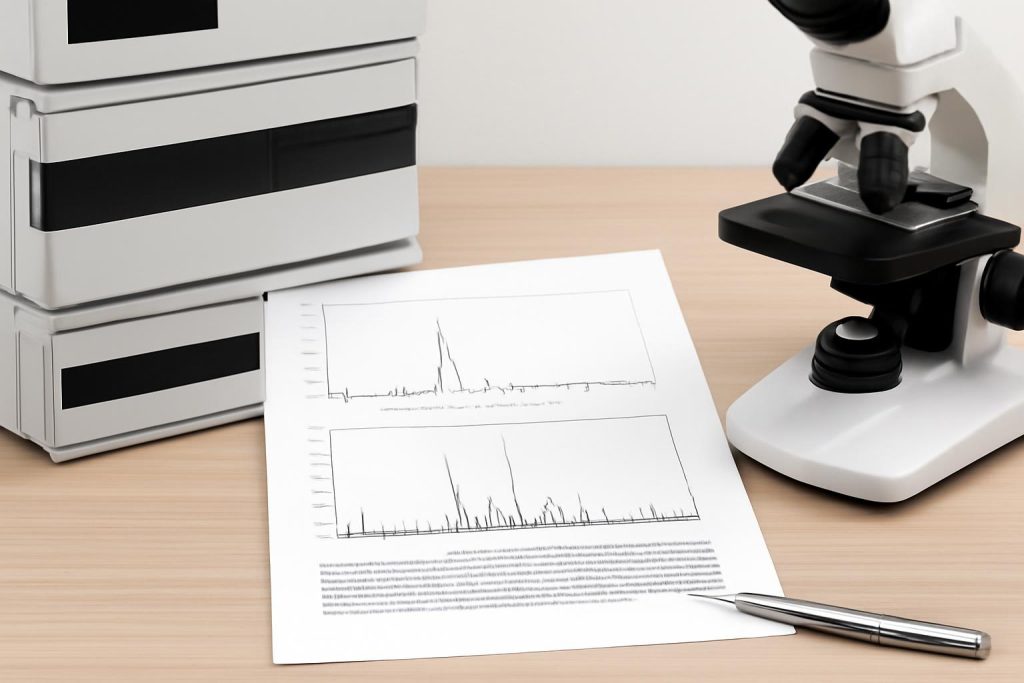
High-performance liquid chromatography separates the chemical components in a sample as they pass through a chromatographic column. The instrument records the compounds as peaks, creating a chromatogram that can be analyzed by a qualified laboratory.
In peptide testing, HPLC is commonly used to estimate chromatographic purity. The principal peptide peak is compared with other detected peaks, such as truncated sequences, deletion products, modified forms, or residual impurities. A report may express the result as a percentage, such as 95%, 98%, or 99% purity.
How to Interpret the Purity Percentage
A stated purity percentage generally refers to the proportion of the detected chromatographic signal associated with the target peak. It does not necessarily mean that 99% of the vial’s total weight is active peptide. Water, salts, counterions, buffers, and other non-chromophoric materials may not be represented in the same way.
For that reason, the number should be read alongside the method and report details. A strong COA should identify the HPLC conditions or provide enough information to show that the result came from a defined analytical procedure. Useful details may include the column type, mobile phase, detection wavelength, run time, sample preparation, and acceptance criteria.
Why the Chromatogram Matters
A single purity number is less informative than a report that includes the chromatogram. The visual trace can show whether the primary peak is clearly separated from secondary peaks and whether the result appears consistent with the stated value.
Researchers should not attempt to judge a chromatogram solely by appearance. Interpretation depends on the compound, method, detector, and laboratory expertise. Still, missing chromatograms, unreadable documents, or reports that show only a generic percentage deserve additional questions.
What Mass Spectrometry Testing Shows
Mass spectrometry measures ions according to their mass-to-charge ratio. In peptide analysis, it is often used to support molecular identity by comparing the observed mass with the expected molecular mass of the target compound.
Where HPLC primarily helps answer “How many detectable components are present under this method?”, mass spectrometry helps answer “Does the major component have the expected molecular mass?” These are complementary questions.
Identity Is Not the Same as Purity
A mass spectrum that is consistent with the expected molecular weight supports identity, but it does not automatically establish high purity. A contaminated sample may still contain the correct peptide along with additional compounds. Likewise, a high HPLC purity result does not, by itself, prove that the main peak is the intended peptide.
That is why research peptides with HPLC and mass spectrometry testing can provide a more useful documentation package than products supported by only one type of result. Laboratories may also use additional techniques, such as amino acid analysis, peptide mapping, residual solvent testing, water content testing, endotoxin analysis, or sterility testing, depending on the intended research application.
What a Useful COA Should Include
A certificate of analysis should be specific to the product and batch being supplied. When reviewing peptide products with COA documentation, look for the following elements:
- Product name: The compound should be clearly identified, including any relevant salt form, sequence designation, or modification.
- Batch or lot number: This should match the label on the container and any associated order records.
- Manufacture or test date: Dates help establish document traceability and support stability review.
- Reported purity: The result should identify the method used, rather than presenting an unsupported percentage.
- Identity data: Mass spectrometry or another validated identity method should be linked to the same batch whenever possible.
- Appearance and physical description: These observations can support basic receiving inspection but are not substitutes for analytical testing.
- Testing laboratory: The document should identify who performed the analysis and, where applicable, provide laboratory accreditation or contact information.
- Approval or review details: A name, signature, electronic approval, or quality review field can improve accountability.
Researchers can browse the available research peptide product catalog and then confirm what documentation is provided for the specific item and batch under consideration. Product listings and analytical records serve different purposes, so both should be reviewed before an order is placed.
Third-Party Testing Versus In-House Testing
In-house testing can be valuable when a supplier operates suitable equipment, qualified personnel, and documented quality procedures. However, testing performed by an independent laboratory may provide an additional layer of review and reduce the risk of relying on a single internal process.
When a supplier describes products as third-party tested research peptides, the phrase should be supported by clear documentation. Ask whether the report identifies the outside laboratory, whether the laboratory tested the exact batch supplied, and whether the report includes the original analytical results rather than only a summary statement.
Accreditation can also be relevant. An ISO/IEC 17025-accredited laboratory, for example, has been assessed against requirements related to testing competence and laboratory management. Accreditation does not mean every possible test is automatically suitable for every purpose, but it can be a useful part of a broader quality review.
Common Red Flags in Peptide Documentation
Not every incomplete document indicates that a product is unsuitable, but certain patterns should prompt caution. These include:
- A COA that does not include a batch or lot number.
- The same report being used for multiple products or unrelated batches.
- A purity claim with no method, chromatogram, or laboratory identification.
- Mass spectrometry data that does not state the expected or observed mass.
- Documents containing inconsistent product names, dates, units, or molecular weights.
- Reports that promise clinical, therapeutic, or performance outcomes rather than describing analytical results.
- Pressure to purchase quickly without time to review quality documentation.
- Claims that a research material is approved for human use when no applicable approval is provided.
A professional peptide supplier should be willing to explain its documentation process in clear language. If a laboratory cannot verify a batch, clarify the test method, or identify the testing facility, buyers should consider whether the product meets their internal purchasing requirements.
Questions to Ask a Peptide Supplier Online
Before placing a small order or a wholesale research peptide purchase, a laboratory can ask several practical questions:
- Is the reported COA specific to the batch being shipped?
- Was HPLC used to assess purity, and is the chromatogram available?
- Was mass spectrometry used to support identity?
- Were the tests performed in-house or by an independent laboratory?
- How are products labeled, packaged, and stored before shipment?
- What documentation is included for larger or bulk peptide products for laboratories?
- Are storage and shipping conditions stated clearly?
- Can the supplier provide additional testing information when a laboratory has specialized requirements?
These questions are useful whether a buyer needs one item for a pilot study or is evaluating a bulk peptide order supplier for recurring research work. Price and availability matter, but documentation, consistency, and communication are equally important when comparing research peptide wholesale prices.
Handling and Storage Still Matter After Testing
Analytical testing describes a sample at a particular point in time. It does not guarantee that a product will remain unchanged if it is exposed to heat, humidity, light, repeated temperature cycling, or unsuitable storage conditions.
Laboratories should follow the supplier’s stated storage guidance and their own institutional procedures. Receiving staff should check the container, label, seal, lot number, and shipping condition. Any discrepancy should be recorded before the material is introduced into a research workflow.
It is also important to keep research peptides separate from materials intended for human or veterinary use. Products sold for laboratory research should not be used for self-administration, diagnosis, treatment, dietary supplementation, or cosmetic procedures. Research status is not the same as regulatory approval or clinical suitability.
Choosing Documentation Over Marketing Language
Terms such as “premium research peptides,” “high-purity research peptides,” and “laboratory peptide supplier USA” may help buyers find relevant products, but they should not be accepted as proof of quality on their own. The most useful evaluation combines product identity, batch-level records, appropriate analytical methods, clear storage information, and responsive supplier communication.
Researchers looking for a reliable source can review the research-grade peptide category and compare the information available for individual products. For broader educational material about peptide handling and laboratory use, the site’s research articles and blog content may provide additional context.
For laboratories, the goal is not simply to find the lowest price or the largest catalog. It is to select materials that can be identified, documented, handled, and evaluated consistently within the research plan.
Frequently Asked Questions
Is a 99% HPLC purity result enough to verify a research peptide?
No. HPLC purity is useful, but it does not independently confirm molecular identity or provide a complete profile of every possible impurity. Mass spectrometry and other tests may be needed depending on the compound and the study.
Does mass spectrometry prove that a peptide is pure?
No. Mass spectrometry can support identity by showing an expected molecular mass, but it does not necessarily quantify all impurities. It should be interpreted alongside HPLC and other relevant analytical data.
What is the difference between a COA and a test report?
A test report typically presents analytical results from a specific procedure. A COA is a quality document that summarizes whether a defined batch meets stated specifications. A COA may reference one or more test reports, but the terminology and format can vary by supplier.
Should laboratories buy research peptides online?
Online purchasing can be practical when the supplier provides clear product information, batch-specific documentation, appropriate packaging, and transparent business policies. Laboratories should complete their own vendor review and confirm that the material is lawful and suitable for their intended non-clinical research.
Are research peptides approved for human use?
Research labeling does not indicate approval for human use. Research peptides should be handled only by qualified personnel in appropriate laboratory settings and must not be used for self-experimentation or medical treatment.
Final Takeaway
HPLC and mass spectrometry are most valuable when used together. HPLC helps assess the chromatographic composition of a sample, while mass spectrometry helps support molecular identity. A batch-specific COA that clearly connects both methods to the supplied product gives laboratories a stronger foundation for vendor evaluation and research planning.
Whether you are comparing peptide products online, reviewing a laboratory peptide supplier, or considering wholesale research peptides, prioritize verifiable documentation over broad marketing claims. Quality records cannot replace good laboratory practice, but they can make purchasing decisions more transparent, consistent, and scientifically defensible.
