
Uncategorized
What Are the Most Popular Peptides People Are Buying Right Now?
Aug
Introduction
Peptide science continues to attract significant attention across biotechnology, pharmaceutical research, metabolic science, and molecular biology. New research publications, advances in peptide synthesis, and growing interest in biological signaling have all contributed to the expanding peptide research market.
When people ask about the most popular peptides, it is important to distinguish between compounds receiving significant research attention and products approved for medical use. Popularity does not necessarily mean that a peptide is proven to be effective, safe, or appropriate for a particular purpose.
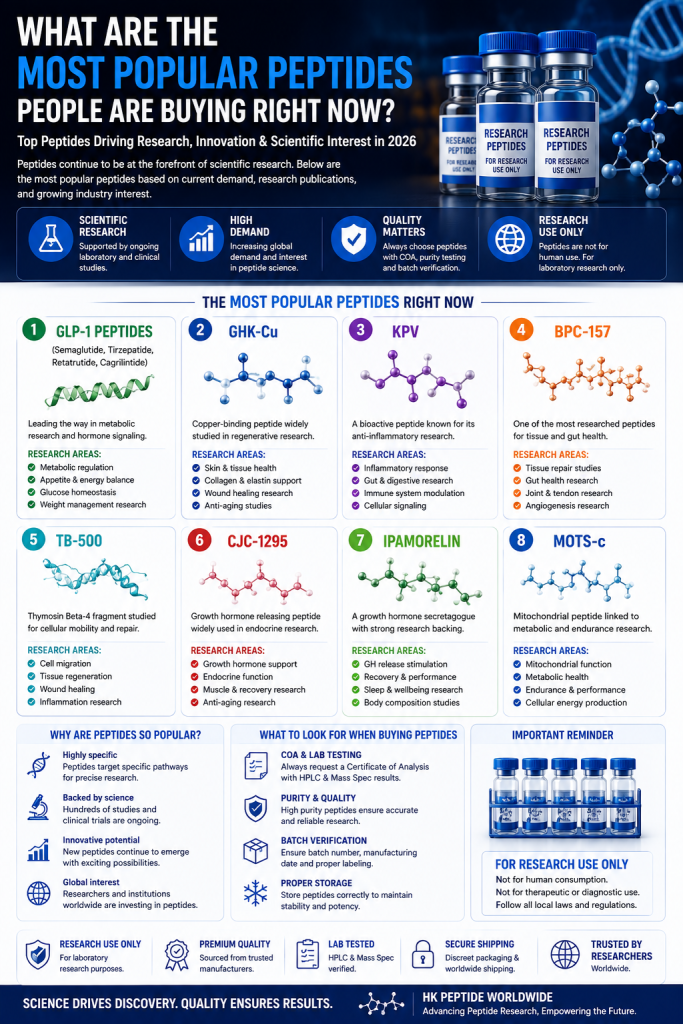
Several peptide categories are currently receiving substantial attention in scientific and biotechnology discussions, including GLP-1-related compounds, GHK-Cu, KPV, BPC-157, TB-500, CJC-1295, and other research compounds.
This article reviews these research trends and explains why particular peptide compounds continue to attract scientific interest.
Research-use notice: Research peptides should only be used within appropriate laboratory settings and according to applicable laws, institutional requirements, and professional protocols. Research interest does not establish human safety or therapeutic effectiveness.
Which Peptides Are Currently Popular in Research?
GLP-1-Related Peptides
GLP-1-related compounds remain one of the largest areas of interest in metabolic research.
Researchers investigate these compounds in relation to:
- Metabolic signaling
- Receptor biology
- Cellular communication
- Energy regulation
- Endocrine pathways
Semaglutide, tirzepatide, and newer investigational compounds have received substantial scientific and pharmaceutical attention.
Read our related article on GLP-1 Peptides and Metabolic Research.
GHK-Cu
Why GHK-Cu Attracts Research Interest
GHK-Cu is a copper-binding peptide that has been investigated in several areas of biological research.
Scientific studies have explored topics involving:
- Cellular signaling
- Extracellular matrix biology
- Skin biology
- Tissue-related pathways
- Molecular interactions
Interest in GHK-Cu continues across cosmetic science, biotechnology, and laboratory research.
Read more about GHK-Cu Peptide Functions.
KPV Peptide
Current KPV Research
KPV is a small tripeptide derived from a region of alpha-melanocyte-stimulating hormone.
Researchers have investigated KPV in areas involving:
- Cellular signaling
- Molecular biology
- Inflammatory pathway research
- Tissue biology
Its small molecular structure and biological activity make it an interesting subject for laboratory research.
See our detailed guide to KPV Peptide Research.
BPC-157
Why BPC-157 Is Frequently Discussed
BPC-157 is frequently discussed in peptide research communities and has been investigated in experimental models.
Research interests include:
- Cellular responses
- Tissue biology
- Molecular signaling
- Experimental physiology
However, laboratory and animal research should not be interpreted as proof of established benefits or safety in humans.
TB-500
Research Interest in TB-500
TB-500 is another compound that receives attention in experimental peptide research.
Researchers have investigated biological processes involving:
- Cellular migration
- Tissue-related pathways
- Molecular signaling
- Experimental models
The available evidence should be evaluated carefully, particularly when distinguishing laboratory findings from established clinical applications.
CJC-1295 and Related Peptides
Growth-Hormone-Related Research
CJC-1295 and other growth-hormone-related compounds remain subjects of endocrine and molecular research.
Scientists investigate areas such as:
- Receptor signaling
- Hormonal communication
- Cellular pathways
- Peptide-receptor interactions
Other compounds discussed in this research area include ipamorelin and GHRP-related peptides.
For more information, see HGH Peptides Online.
Retatrutide and Emerging Metabolic Research
A Newer Area of Scientific Interest
Retatrutide has attracted considerable attention because of its multi-receptor activity and its role in metabolic research.
Research has focused on:
- Metabolic pathways
- Hormonal signaling
- Receptor interactions
- Energy regulation
As an investigational compound, its research status should be distinguished from approved medical treatments.
Cagrilintide
Interest in Amylin-Related Research
Cagrilintide is another compound receiving attention in metabolic research.
Researchers investigate its interaction with biological pathways associated with:
- Metabolic regulation
- Appetite-related signaling
- Hormonal communication
- Energy balance
Research into combinations involving different metabolic signaling pathways is also an active area of scientific investigation.
Why Are Peptides Becoming More Popular?
Growing Biotechnology Research
Peptides can interact with highly specific biological targets, making them useful tools for investigating molecular pathways.
Advances in:
- Peptide synthesis
- Molecular biology
- Analytical chemistry
- Computational biology
- Drug discovery
continue to expand the possibilities for peptide research.
Improved Laboratory Testing
Modern analytical methods make it easier to characterize research materials.
Common quality-control techniques include:
- HPLC
- Mass Spectrometry
- Chromatographic analysis
- Batch testing
- Certificate of Analysis documentation
Learn more about Peptide Safety and Quality.
Popularity Does Not Equal Proven Effectiveness
Understanding the Difference
A peptide can become popular because of scientific publications, online discussion, pharmaceutical development, or biotechnology investment.
That does not automatically mean that:
- It is approved for a particular use
- It is safe for everyone
- Research findings apply to humans
- Long-term effects are established
- A product from every supplier has the same quality
Researchers and readers should distinguish scientific interest from established clinical evidence.
How to Evaluate Peptide Research Information
Look for Scientific Evidence
When researching a peptide, consider:
- Peer-reviewed publications
- Study design
- Research models
- Sample sizes
- Reproducibility
- Limitations of the evidence
A single study rarely provides a complete picture.
Consider Product Quality
For laboratory research, product documentation can also be important.
Researchers may evaluate:
- Product identity
- Purity
- Batch number
- COA documentation
- Analytical testing
- Supplier transparency
Read our article on COA Tested Peptides for more information.
What Could Become Popular Next?
Peptide research continues to evolve rapidly.
Future areas of interest may include:
- New metabolic peptides
- Multi-receptor compounds
- Peptides designed for specific biological targets
- AI-assisted peptide discovery
- Novel peptide delivery systems
- Advanced peptide therapeutics
The popularity of individual compounds can change as new clinical trials, publications, and regulatory decisions become available.
Conclusion
The peptide landscape continues to change as research advances. GLP-1-related compounds, GHK-Cu, KPV, BPC-157, TB-500, CJC-1295, retatrutide, and cagrilintide are among the compounds receiving significant attention in different areas of peptide and biotechnology research.
However, popularity should not be confused with proven safety or effectiveness. Researchers should evaluate scientific evidence, regulatory status, product documentation, and laboratory testing when assessing peptide-related information.
As peptide science develops, transparent research and reliable analytical standards will remain essential.
Frequently Asked Questions
What are the most popular peptides right now?
Among compounds receiving substantial research and industry attention are GLP-1-related peptides, GHK-Cu, KPV, BPC-157, TB-500, CJC-1295, retatrutide, and cagrilintide.
Why are GLP-1-related peptides so widely researched?
They are an important area of metabolic research involving receptor signaling, endocrine biology, and cellular communication.
Is a popular peptide necessarily safe?
No. Popularity does not establish safety, effectiveness, or regulatory approval.
What should researchers look for when evaluating peptide quality?
Researchers can review product identity, purity, batch information, COAs, HPLC results, Mass Spectrometry data, and supplier transparency.
Are all peptides approved medicines?
No. Some peptides are approved medicines for specific indications, while others remain investigational or are used only as laboratory research materials.
