
Uncategorized
Peptide Safety and Quality: Understanding Standards for Reliable Research Peptides
Aug
Introduction
Peptides have become an important part of modern scientific research. Laboratories, biotechnology companies, and research organizations use peptide compounds to investigate cellular signaling, molecular interactions, metabolic pathways, tissue biology, and other areas of science.
As the peptide industry continues to grow, peptide safety and quality have become increasingly important topics. Researchers need reliable information about the identity, purity, testing, handling, and documentation of the materials used in laboratory studies.
Choosing a peptide based only on price or a product description can leave important questions unanswered. A professional research supplier should provide clear product information and appropriate analytical documentation so researchers can evaluate materials before incorporating them into controlled laboratory work.
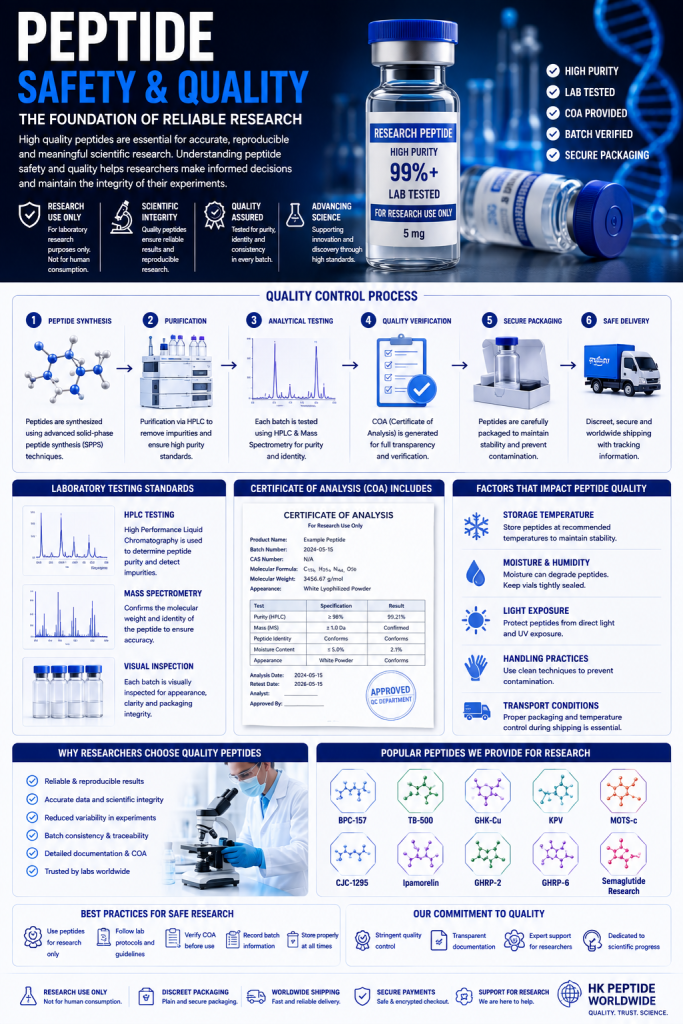
This guide explains the most important aspects of peptide safety and quality, including laboratory testing, Certificates of Analysis, supplier transparency, storage considerations, and responsible research practices.
Research-use notice: Research peptides are intended for controlled laboratory and scientific research. They should not be presented as approved medicines or products for human or veterinary use.
What Does Peptide Quality Mean?
Understanding Peptide Quality
Peptide quality refers to the characteristics that determine whether a research material matches its stated specifications.
Important quality factors can include:
- Peptide identity
- Purity
- Molecular weight
- Batch consistency
- Analytical testing
- Manufacturing controls
- Documentation
- Packaging and labeling
Quality should be evaluated using objective laboratory information rather than marketing claims alone.
Why Peptide Purity Matters
Purity is one of the most frequently discussed characteristics of research peptides.
A peptide sample can contain the intended compound alongside impurities or synthesis-related byproducts. Analytical testing helps researchers understand the composition of a particular batch.
High-quality research materials can help laboratories reduce unnecessary variability and improve the consistency of experimental work.
However, a high purity percentage by itself does not guarantee that a product is suitable for every research application. Researchers should consider identity, testing methodology, batch information, and the requirements of their specific study.
Certificate of Analysis and Peptide Quality
What Is a COA?
A Certificate of Analysis, commonly called a COA, is a laboratory document that provides analytical information about a product or batch.
A useful COA may include:
- Product name
- Batch or lot number
- Purity result
- Testing date
- Testing methods
- Molecular information
- Laboratory identification
Researchers can use this information when evaluating the quality and consistency of research materials.
Why Batch-Specific Documentation Matters
Batch information is particularly important for research projects that require consistency over time.
A batch-specific COA allows researchers to connect analytical results with the particular material they have received.
This can make laboratory records more organized and improve traceability.
Learn more in our article on COA Tested Peptides
HPLC Testing for Peptides
What Is HPLC?
High-Performance Liquid Chromatography, commonly known as HPLC, is an analytical technique widely used to evaluate chemical and peptide samples.
In peptide research, HPLC can help researchers assess:
- Relative purity
- Potential impurities
- Separation of compounds
- Batch consistency
HPLC results can provide valuable information when evaluating a peptide product.
Understanding HPLC Results
Researchers should avoid interpreting an HPLC percentage without considering the complete laboratory report.
Important details include:
- Testing method
- Sample identification
- Chromatogram information
- Reported purity
- Batch number
- Testing laboratory
A transparent report provides more useful information than a single number displayed on a product page.
Mass Spectrometry and Peptide Identity
What Is Mass Spectrometry?
Mass Spectrometry, often abbreviated as MS, is another important analytical technique used in peptide research.
It can help researchers evaluate molecular mass and support identification of the expected peptide.
When combined with other analytical methods, Mass Spectrometry can provide additional confidence in product identity.
Why Identity Verification Matters
A peptide may have a similar name to another compound while having a different molecular structure or sequence.
Identity verification helps researchers distinguish between compounds and maintain accurate laboratory records.
For this reason, professional quality control should consider both purity and identity.
Peptide Safety and Laboratory Handling
Follow Laboratory Procedures
Research peptides should be handled according to appropriate laboratory procedures and applicable institutional requirements.
Researchers should consider:
- Appropriate personal protective equipment
- Clean laboratory environments
- Proper labeling
- Controlled access
- Appropriate waste procedures
- Documented laboratory protocols
The specific requirements depend on the compound, research setting, and applicable regulations.
Clear Product Labeling
Proper labeling is an important part of laboratory organization.
Labels should clearly identify relevant information such as:
- Product name
- Batch number
- Research designation
- Relevant storage information
- Date information where applicable
Clear labels reduce the possibility of confusion between research materials.
Peptide Storage and Stability
Why Storage Matters
Peptide stability can be affected by environmental conditions. Factors such as temperature, moisture, light, and repeated handling may influence the condition of a research material.
Researchers should follow the storage information provided by the manufacturer or supplier and consult appropriate scientific documentation.
Maintaining Product Integrity
Good laboratory storage practices can help researchers maintain consistent materials.
General quality-control considerations include:
- Keeping containers properly closed
- Following the supplier’s storage specifications
- Avoiding unnecessary environmental exposure
- Maintaining organized inventory records
- Monitoring relevant storage conditions
Researchers should always consult compound-specific documentation rather than assuming that every peptide has identical storage requirements.
Choosing a Transparent Peptide Supplier
Look for Clear Documentation
A reputable research peptide supplier should make important quality information accessible.
Researchers should look for:
- COAs
- Analytical testing
- Product specifications
- Batch information
- Research-use statements
- Contact information
Transparency allows researchers to evaluate a supplier before making a purchasing decision.
Evaluate Supplier Communication
Good communication is another important part of supplier quality.
A professional supplier should be able to provide clear information about:
- Product specifications
- Testing documentation
- Ordering procedures
- Shipping policies
- Storage information
Clear communication reduces uncertainty and supports better purchasing decisions.
Read our article about Supplier Transparency.
Common Peptide Quality Mistakes to Avoid
Choosing Based Only on Price
A very low price does not necessarily indicate good value.
Researchers should compare the complete quality profile of a product, including analytical documentation and supplier transparency.
Relying Only on Purity Claims
A product advertised as highly pure should still have appropriate supporting documentation.
Purity is important, but identity, batch information, and testing methodology are also essential.
Ignoring Batch Information
Without batch information, it can be more difficult to connect a product with its laboratory testing.
Batch traceability is particularly valuable for long-term research projects.
Assuming Every Supplier Uses the Same Standards
Quality-control practices can vary considerably between suppliers.
Researchers should independently evaluate available documentation instead of assuming that every peptide product has undergone identical testing.
Peptide Safety and Quality in 2026
Greater Demand for Transparency
The peptide research market continues to mature. Researchers increasingly expect suppliers to provide detailed information about product quality and testing.
Important areas include:
- Batch traceability
- Analytical verification
- Manufacturing documentation
- Clear product labeling
- Transparent supplier policies
Advances in Laboratory Testing
Analytical technologies continue to improve, providing researchers with increasingly detailed information about peptide identity and composition.
Modern quality-control systems may combine multiple analytical approaches rather than relying on a single test.
Artificial Intelligence and Peptide Research
Artificial intelligence is also becoming increasingly relevant to peptide science.
Researchers can use computational technologies to analyze large datasets, investigate molecular relationships, and support peptide discovery.
As computational research develops, reliable experimental data and high-quality research materials will remain essential.
Why Research-Grade Quality Matters
Supporting Reproducible Research
Reproducibility is one of the most important principles in scientific research.
When researchers use well-characterized materials, maintain accurate records, and follow consistent laboratory procedures, it becomes easier to compare experimental results.
Quality control therefore contributes to the broader scientific process.
Supporting Long-Term Studies
Long-term research may involve multiple peptide batches over an extended period.
Consistent documentation and batch identification can help researchers track differences between materials and maintain organized research records.
A Practical Peptide Quality Checklist
Before selecting a research peptide supplier, researchers can review the following checklist:
Product Information
Is the peptide clearly identified?
Purity
Is a laboratory-supported purity result available?
COA
Is a Certificate of Analysis available for the relevant batch?
HPLC
Is HPLC testing documented where appropriate?
Mass Spectrometry
Is molecular identity supported by appropriate analytical testing?
Batch Information
Can the product be traced to a specific batch or lot?
Supplier Transparency
Does the supplier clearly explain its quality-control practices?
Research-Use Information
Does the supplier clearly identify the intended research purpose?
This checklist can help researchers compare suppliers more systematically.
The Future of Peptide Safety and Quality
The future of peptide research will likely involve even greater emphasis on analytical verification and transparent quality systems.
Emerging trends include:
- More comprehensive testing
- Improved batch traceability
- Advanced analytical technologies
- Better digital documentation
- AI-assisted peptide research
- Stronger quality-control practices
As the industry develops, researchers will continue to benefit from suppliers that prioritize scientific documentation over unsupported marketing claims.
Conclusion
Peptide safety and quality are essential considerations when selecting materials for laboratory research. Purity, identity, analytical testing, batch documentation, storage information, and supplier transparency all contribute to the overall quality of a research peptide.
COAs, HPLC testing, and Mass Spectrometry can provide valuable information for evaluating research materials. At the same time, researchers should maintain appropriate laboratory procedures and follow applicable institutional and regulatory requirements.
For anyone comparing peptide suppliers online, the strongest approach is to look beyond price and product claims. Reliable documentation, transparent quality-control practices, and clear research-use information provide a much stronger foundation for informed scientific research.
Frequently Asked Questions
What is peptide quality?
Peptide quality refers to characteristics such as identity, purity, batch consistency, analytical testing, documentation, and manufacturing controls.
Why is a COA important for research peptides?
A COA provides analytical information about a product or batch and can help researchers evaluate identity and purity.
What is HPLC testing used for?
HPLC can be used to evaluate peptide purity and identify potential impurities or differences between compounds.
What does Mass Spectrometry tell researchers?
Mass Spectrometry can help confirm molecular mass and support identification of the expected peptide.
Why is supplier transparency important?
Transparent suppliers provide useful information about testing, batches, product specifications, and quality-control practices.
Does high purity automatically mean a peptide is high quality?
Not necessarily. Researchers should consider purity together with identity verification, analytical methods, batch information, and documentation.
How should research peptides be stored?
Storage requirements vary between compounds. Researchers should follow the specific storage instructions provided with the research material and applicable laboratory procedures.
