
Uncategorized
Top Peptide Compounds for Muscle Development and Recovery in Modern Research
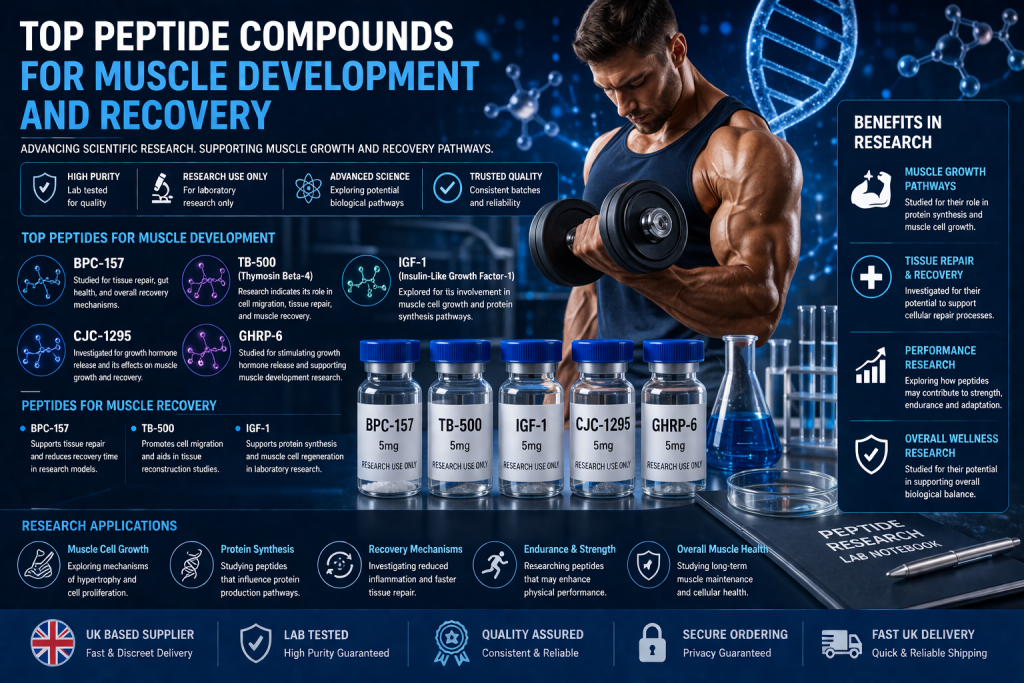
May
Introduction: The Growing Interest in Peptides for Muscle Research
In recent years, scientific interest in muscle development and recovery has expanded significantly. Researchers are constantly exploring new ways to better understand how muscle tissue grows, repairs, and adapts to stress. Among the most promising tools in this field are peptides.
Peptides are short chains of amino acids that can interact with biological systems in precise and targeted ways. Because of their flexibility and specificity, they are widely used in laboratory research to study muscle biology, protein synthesis, and recovery mechanisms.
As research advances, certain peptide compounds have become particularly popular for studying muscle-related processes. This article explores the top peptide compounds used in muscle development and recovery research, their scientific relevance, and why they continue to gain attention in 2026.
Understanding Peptides in Muscle Research
What Are Muscle-Related Peptides?
Muscle-related peptides are compounds studied for their interaction with biological pathways involved in muscle growth, repair, and recovery. These peptides are used in controlled laboratory environments to explore how muscles respond to stress, injury, and adaptation.
Why Peptides Are Used in Muscle Studies
Peptides are ideal for muscle research because they offer:
- High specificity in targeting biological pathways
- Controlled experimental design
- Predictable molecular interactions
- Compatibility with modern laboratory techniques
These properties make peptides valuable tools for understanding complex muscle-related processes.
Top Peptide Compounds for Muscle Development Research
BPC-157
BPC-157 is one of the most widely studied peptides in muscle and tissue research. It is commonly explored for its role in biological repair mechanisms.
Researchers focus on:
- Tissue response to stress
- Structural recovery processes
- Cellular signaling related to repair
Its versatility makes it a key compound in muscle-related studies.
TB-500 (Thymosin Beta-4)
TB-500 is another important peptide in muscle research. It is associated with cellular movement and structural organization.
Key research areas include:
- Cellular migration
- Tissue structure analysis
- Recovery-related biological pathways
TB-500 is often studied alongside other peptides to understand combined effects in research models.
IGF-1 (Insulin-Like Growth Factor-1)
IGF-1 is widely studied for its role in growth-related biological processes. It plays an important part in cellular development and protein synthesis.
Research applications include:
- Muscle cell growth studies
- Protein interaction analysis
- Cellular signaling pathways
IGF-1 remains a central focus in muscle development research.
CJC-1295
CJC-1295 is commonly studied in research involving biological signaling pathways related to growth processes.
Scientists use it to explore:
- Hormonal signaling pathways
- Cellular communication systems
- Growth-related biological responses
GHRP-6 (Growth Hormone Releasing Peptide-6)
GHRP-6 is another peptide frequently examined in muscle-related studies. It is used to investigate how biological systems regulate growth signals.
Research focuses include:
- Signaling pathway activation
- Cellular response mechanisms
- Interaction with growth-related systems
Peptides for Muscle Recovery Research
Understanding Recovery Mechanisms
Muscle recovery involves complex biological processes, including tissue repair, inflammation response, and cellular regeneration. Peptides help researchers isolate and study these processes in detail.
Key Peptides in Recovery Studies
Several peptides are frequently used to study recovery-related processes:
- BPC-157 – studied for tissue repair mechanisms
- TB-500 – associated with cellular movement and regeneration
- IGF-1 – linked to growth and recovery pathways
These compounds allow researchers to examine how muscles respond after stress or damage.
How Peptides Support Muscle Research
Studying Protein Synthesis
Protein synthesis is a key factor in muscle development. Peptides help researchers analyze how proteins are produced and regulated within muscle cells
Investigating Cellular Adaptation
Muscles adapt to stress through complex signaling pathways. Peptides provide a controlled way to study these adaptive responses.
Modeling Muscle Stress and Repair
Peptides are used to simulate conditions such as:
- Physical stress
- Cellular damage
- Recovery processes
This helps scientists better understand muscle behavior under different conditions.
Advances in Peptide Research Technology
Improved Peptide Synthesis
Modern synthesis techniques allow for the production of high-purity peptides with precise sequences. This improves the reliability of muscle research experiments.
Artificial Intelligence in Research
AI tools are increasingly used to analyze peptide interactions and predict outcomes. This helps researchers design more efficient experiments.
Challenges in Muscle Peptide Research
Complexity of Biological Systems
Muscle development and recovery involve multiple biological pathways. Peptides help simplify these systems, but research still requires careful design.
Need for Standardized Protocols
Different laboratories may use different methods, leading to variations in results. Standardization is essential for consistency.
Ethical and Research Considerations
Research Use Only
Peptides discussed in this article are intended strictly for laboratory research. They are not for personal or unsupervised use.
Importance of Scientific Integrity
Accurate reporting and responsible research practices are essential for advancing knowledge in muscle biology.
The Future of Peptides in Muscle Research
Growing Scientific Interest
Research into muscle development and recovery continues to expand, with peptides playing a central role in new discoveries.
Integration with Advanced Technologies
Peptide research is increasingly combined with:
- Artificial intelligence
- Biotechnology tools
- Molecular analysis systems
This integration is expected to accelerate progress in the field.
Frequently Asked Questions (FAQ)
What are peptides used for in muscle research?
Peptides are used to study muscle growth, repair mechanisms, and cellular signaling pathways.
Why are peptides important in recovery studies?
They allow researchers to isolate and analyze biological processes involved in tissue repair.
What makes BPC-157 popular in research?
Its association with tissue repair and cellular response mechanisms.
Are these peptides used outside research?
They are intended primarily for controlled scientific research environments.
What is the future of muscle peptide research?
Continued growth driven by technology, innovation, and global scientific collaboration.
