
Uncategorized
Peptide Synthesis: How Peptides Are Made, Purified and Tested
Oct
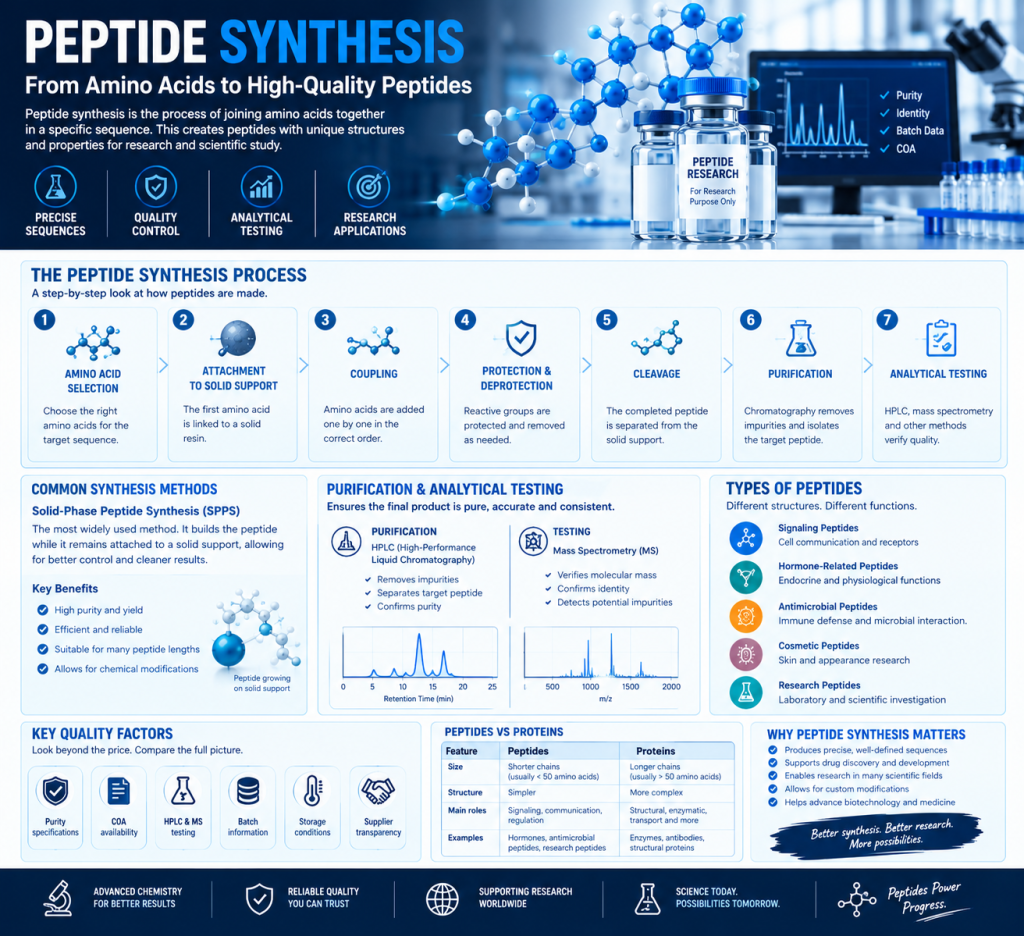
Peptide synthesis is the process of creating peptides by joining amino acids together in a specific sequence. It is an important part of modern biochemical research, pharmaceutical development, biotechnology, and laboratory science.
With growing interest in peptide research, understanding how peptides are synthesized, how they are purified, and how their identity and quality are evaluated has become increasingly important.
Whether you are researching peptide chemistry, evaluating research materials, or learning how peptide manufacturing works, the synthesis process provides important insight into the quality and characteristics of the final product.
What Is Peptide Synthesis?
Peptide synthesis is the controlled process of assembling amino acids into a specific peptide sequence.
A peptide consists of amino acids connected through peptide bonds. By arranging amino acids in a particular order, scientists can create peptide molecules with specific structures and biological properties.
The basic concept is straightforward, but producing a high-quality peptide can involve multiple stages, including:
- Amino acid selection
- Sequence assembly
- Protection and deprotection chemistry
- Cleavage
- Purification
- Analytical testing
- Quality control
The exact process depends on the peptide, its length, chemical characteristics, and intended research application.
How Are Peptides Synthesized?
One of the most widely used approaches is solid-phase peptide synthesis, commonly abbreviated as SPPS.
Instead of allowing the growing peptide to remain freely dissolved throughout the entire synthesis, the peptide chain is assembled while attached to a solid support.
This approach allows researchers to build the sequence progressively and remove unwanted reaction components between stages.
Solid-Phase Peptide Synthesis
SPPS was developed as a major advancement in peptide chemistry because it simplified the process of assembling peptide chains.
At a high level, the process involves:
- Attaching the initial amino acid to a solid support.
- Adding amino acids sequentially according to the desired sequence.
- Protecting reactive chemical groups during synthesis.
- Removing temporary protecting groups between coupling stages.
- Repeating the process until the desired sequence is assembled.
- Separating the completed peptide from the solid support.
- Purifying the resulting material.
- Performing analytical testing.
This overview describes the scientific principle rather than a laboratory operating procedure. Actual synthesis requires specialized equipment, chemical controls, validated methods, and trained personnel.
Why Is Amino Acid Sequence Important?
The amino acid sequence determines much of a peptide’s structure and behavior.
Even a small sequence difference can produce a different peptide with different molecular characteristics.
For this reason, researchers pay close attention to:
- Amino acid identity
- Sequence order
- Molecular mass
- Chemical modifications
- Purity
- Structural characteristics
- Potential impurities
Accurate sequence control is particularly important when researchers are investigating relationships between peptide structure and biological activity.
Peptide Synthesis vs Protein Synthesis
Peptide synthesis and protein production are related but are not identical.
Peptide synthesis generally focuses on assembling relatively short amino acid sequences through chemical methods. Protein production often involves biological expression systems, such as engineered microorganisms or cultured cells.
| Peptide Synthesis | Protein Production |
|---|---|
| Often uses chemical synthesis | Often uses biological expression |
| Suitable for many short sequences | Commonly used for larger proteins |
| Sequence can be precisely designed | Depends on an expression system |
| Chemical modifications can be introduced | Modifications depend on the production system |
| Purification follows synthesis | Purification follows biological production |
The most appropriate method depends on the molecule being produced and the research objective.
What Is Solid-Phase Peptide Synthesis Used For?
SPPS has applications across many areas of scientific research.
Pharmaceutical Research
Scientists use synthesized peptides to investigate biological targets, molecular interactions, and potential therapeutic candidates.
Molecular Biology
Synthetic peptides can be useful tools for studying proteins, antibodies, receptors, enzymes, and cellular signaling.
Biochemistry
Researchers can use defined peptide sequences to investigate structure-function relationships and biochemical interactions.
Immunology Research
Synthetic peptides can be studied in research involving immune recognition, antigenic sequences, and antibody interactions.
Cosmetic Science
Certain synthetic peptides are investigated in cosmetic and skin science for their interactions with biological pathways and structural proteins.
Why Are Peptides Purified After Synthesis?
Peptide synthesis does not automatically produce a completely pure final material.
The synthesis process can result in related compounds and other impurities. These may originate from incomplete reactions, sequence-related byproducts, residual reagents, or other sources.
Purification is therefore an important stage in peptide production.
Common Purification Approach
Chromatographic techniques are widely used in peptide purification.
High-performance liquid chromatography, or HPLC, is particularly important in peptide analysis and purification.
Depending on the peptide and manufacturing process, researchers may use different chromatographic strategies to separate the desired peptide from related compounds.
How Is Peptide Purity Tested?
Purity testing helps determine how much of the analyzed material corresponds to the intended peptide.
HPLC is commonly used to evaluate chromatographic purity.
However, purity is only one part of overall peptide characterization.
Researchers may also examine:
- Molecular mass
- Peptide identity
- Sequence characteristics
- Residual impurities
- Water or solvent content
- Related substances
- Batch consistency
A strong analytical package provides more useful information than a single percentage printed on a product page.
What Is Mass Spectrometry Used For?
Mass spectrometry, often abbreviated as MS, can provide important information about a peptide’s molecular mass.
When combined with other analytical techniques, mass spectrometry can help researchers assess whether the detected material is consistent with the expected peptide.
HPLC and mass spectrometry therefore serve different but complementary analytical purposes.
HPLC can help evaluate chromatographic purity, while mass spectrometry can provide information related to molecular mass and identity.
What Is a Certificate of Analysis?
A Certificate of Analysis, or COA, is a document that provides analytical information about a particular batch of material.
For research peptides, a useful COA may include information such as:
- Product or peptide name
- Batch or lot number
- Testing date
- Purity result
- Analytical method
- Molecular mass information
- Laboratory information
- Specification and result data
Researchers should review the actual documentation available for the specific batch rather than relying solely on general marketing statements.
What Affects Peptide Synthesis Quality?
Several factors can influence the quality of a synthesized peptide.
Peptide Length
Longer sequences can become increasingly challenging to synthesize accurately because each additional synthesis stage can introduce opportunities for incomplete reactions or related impurities.
Sequence Complexity
Certain sequences can present additional chemical challenges because of their amino acid composition or structural characteristics.
Purification
Effective purification is important for separating the desired peptide from related compounds.
Analytical Testing
Testing provides evidence that helps characterize the final material.
Storage and Handling
Peptides can have different stability characteristics. Appropriate storage and handling requirements should therefore be determined according to the specific material and supporting documentation.
Why Peptide Quality Control Matters
Quality control helps researchers understand what they are working with.
For research materials, important evaluation points include:
Identity: Is the material consistent with the intended peptide?
Purity: What proportion of the analyzed material meets the stated specification?
Batch information: Can the material be traced to a specific production batch?
Testing: Are appropriate analytical methods documented?
Transparency: Is supporting information available for researchers to review?
These factors can be particularly important when comparing peptide research materials from different sources.
Peptide Synthesis and Research-Grade Materials
Researchers evaluating synthetic peptides should look beyond price alone.
A lower-cost material may not provide the same level of analytical documentation, purity information, or batch traceability as another product.
A more complete comparison can include:
- Stated purity
- COA availability
- HPLC information
- Mass spectrometry information
- Batch identification
- Manufacturing information
- Storage documentation
- Supplier transparency
This makes it easier to evaluate materials according to the requirements of a particular research project.
Frequently Asked Questions About Peptide Synthesis
What is peptide synthesis?
Peptide synthesis is the process of chemically assembling amino acids into a specific peptide sequence. The resulting material can then be purified and analytically characterized.
What is solid-phase peptide synthesis?
Solid-phase peptide synthesis is a widely used chemical method in which amino acids are assembled sequentially while the growing peptide remains attached to a solid support.
How are synthetic peptides purified?
Synthetic peptides can be purified using separation techniques such as chromatography. HPLC is widely used in peptide purification and analytical testing.
How is peptide purity measured?
HPLC is commonly used to evaluate chromatographic purity. Additional analytical techniques can provide information about molecular mass, identity, and related characteristics.
Why is mass spectrometry used for peptides?
Mass spectrometry can provide information about molecular mass and can help researchers evaluate whether a material is consistent with the expected peptide.
What is a peptide COA?
A peptide COA is a Certificate of Analysis containing analytical information about a particular batch. It may include purity results, testing methods, batch information, and other specifications.
Is peptide synthesis the same as protein synthesis?
No. Peptide synthesis commonly refers to chemical assembly of peptide sequences, while larger proteins are frequently produced using biological expression systems.
The Future of Peptide Synthesis
Advances in peptide chemistry continue to expand the possibilities for synthetic peptide research.
Researchers are investigating improved synthesis methods, purification technologies, analytical techniques, modified peptide structures, and more efficient manufacturing approaches.
As peptide research continues to grow, reliable characterization will remain just as important as synthesis itself.
The combination of precise synthesis, effective purification, analytical testing, and transparent documentation provides the foundation for better research materials.
Final Thoughts
Peptide synthesis is a fundamental technology behind much of modern peptide research. From amino acid sequence assembly to purification and analytical characterization, each stage contributes to the quality and identity of the final material.
Understanding how peptides are synthesized and tested can help researchers make more informed decisions when evaluating research materials.
For legitimate laboratory research, documentation such as COAs, HPLC results, mass spectrometry data, batch information, and clear product specifications can provide valuable insight into the material being evaluated.
Research-use notice: This article is provided for educational and scientific research information. It does not provide laboratory synthesis instructions, medical advice, dosing guidance, or instructions for human use. Research materials should be handled by appropriately qualified personnel and used in accordance with applicable laws, laboratory procedures, and institutional requirements.
