
Uncategorized
What Are Peptides? Explanation, Types, Uses and Research
Oct
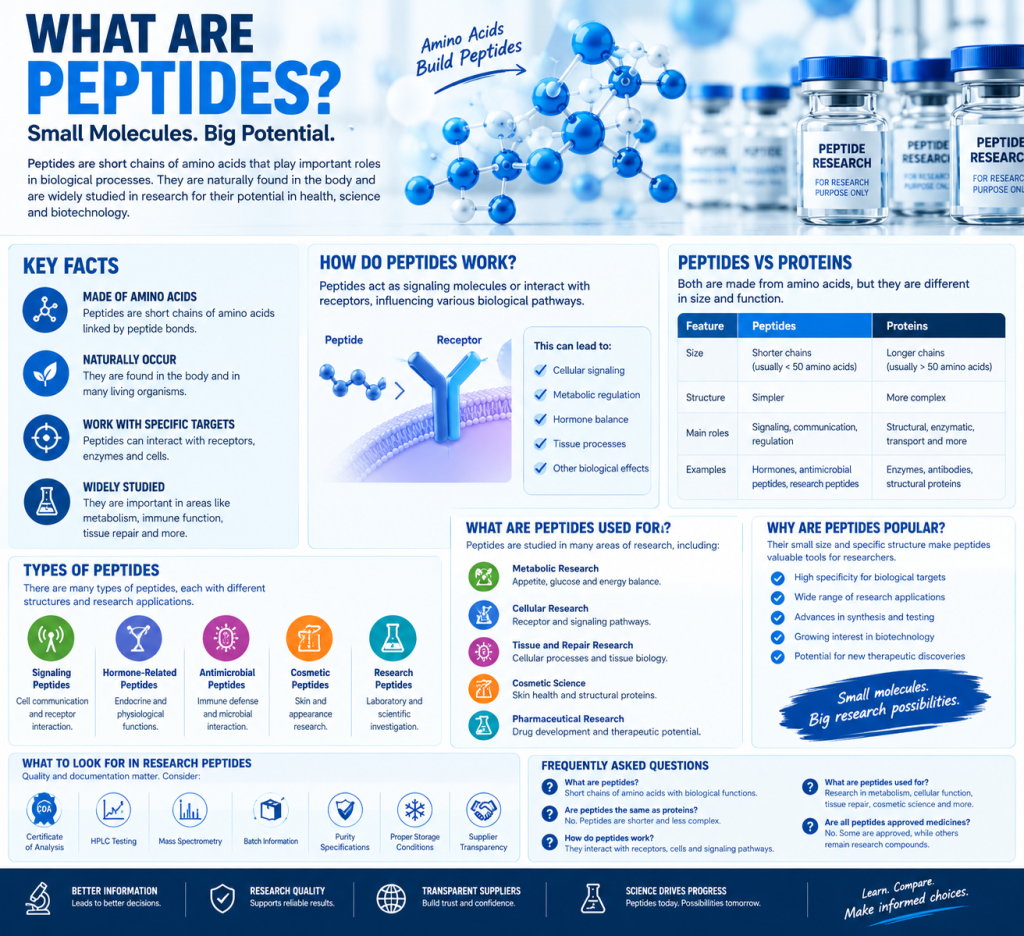
Peptides are short chains of amino acids that play important roles in biological processes. They are naturally found throughout the body and are also widely studied in laboratories for their potential roles in signaling, cellular communication, metabolism, tissue processes, and other areas of scientific research.
If you have searched for “what are peptides,” “how do peptides work,” or “what are peptides used for,” understanding their basic structure and biological function is a useful starting point.
What Are Peptides?
Peptides are molecules made from amino acids linked together by peptide bonds. Amino acids are the building blocks used to form peptides and proteins.
Generally, peptides contain fewer amino acids than proteins, although there is no single universal cutoff that perfectly separates the two. Their relatively small structure allows many peptides to interact with specific biological targets.
Researchers study peptides because their structures can influence how they interact with receptors, enzymes, cells, and other biological systems.
How Do Peptides Work?
The answer depends on the specific peptide.
Some peptides act as signaling molecules. Others can interact with receptors or influence biological pathways. Certain naturally occurring peptides are involved in processes related to metabolism, immune signaling, tissue communication, and cellular activity.
In laboratory research, scientists examine these interactions to better understand how peptide structures relate to biological functions.
Peptide Structure Matters
Small changes in an amino acid sequence can affect how a peptide behaves.
Researchers may therefore investigate:
- Amino acid sequence
- Molecular structure
- Receptor interactions
- Stability
- Biological activity
- Metabolic pathways
- Cellular signaling
- Structure-function relationships
This is one reason peptide research covers such a wide range of scientific fields.
Peptides vs Proteins
One of the most common questions is “What is the difference between peptides and proteins?”
Both are made from amino acids, but peptides are generally shorter chains.
| Peptides | Proteins |
|---|---|
| Usually shorter amino acid chains | Generally longer and more complex |
| Often involved in signaling and biological communication | Perform many structural and functional roles |
| Can have highly specific molecular targets | Can contain multiple functional regions |
| Widely studied in pharmaceutical and biological research | Fundamental to many biological processes |
The distinction is based largely on size and structure rather than a simple biological rule.
What Are Peptides Used For?
Peptides are studied across many areas of scientific research.
Metabolic Research
Researchers investigate peptides involved in metabolic signaling, appetite-related pathways, glucose regulation, and energy balance.
Some peptide-based compounds are also being investigated in pharmaceutical development.
Cellular Research
Certain peptides are studied for their interactions with cells, receptors, proteins, and signaling pathways.
This can help researchers understand biological mechanisms at the cellular level.
Tissue and Repair Research
Some peptides are investigated in connection with cellular processes and tissue biology. Research in this area remains highly compound-specific, and laboratory findings should not automatically be interpreted as established human outcomes.
Cosmetic and Skin Research
Peptides are also widely studied in cosmetic science. Certain peptide sequences are investigated for their interactions with skin-related biological pathways and structural proteins.
Pharmaceutical Research
Peptides have become an important area of drug-development research. Their ability to interact with specific biological targets makes them useful candidates for investigating new therapeutic approaches.
Common Types of Peptides
There are many categories of peptides, and each can have a different structure and research purpose.
Signaling Peptides
Signaling peptides can interact with receptors and participate in biological communication.
Researchers study these molecules to understand how signals are transmitted between cells and tissues.
Hormone-Related Peptides
Some naturally occurring hormones are peptides or proteins. Research into these molecules can provide insight into endocrine signaling and physiological processes.
Antimicrobial Peptides
Antimicrobial peptides are naturally occurring components of immune defense in many organisms. Scientists study their mechanisms and interactions with microorganisms.
Cosmetic Peptides
Cosmetic peptides are commonly investigated in skin science and formulation research. Their properties can vary significantly depending on the sequence and formulation.
Research Peptides
The term research peptides generally refers to peptide compounds supplied for laboratory and scientific investigation rather than approved consumer use.
The exact research status of a compound depends on the individual substance, jurisdiction, and intended application.
Why Are Peptides Popular in Research?
Interest in peptide research has increased because scientists can investigate highly specific molecular interactions.
Researchers can study peptides at several levels, including:
- Molecular structure
- Receptor binding
- Cellular signaling
- Metabolic pathways
- Protein interactions
- Pharmacology
- Drug development
This broad research potential has made peptides an important subject across biotechnology, pharmaceutical science, molecular biology, and related fields.
What Should You Look for in Research Peptides?
When evaluating peptide materials for legitimate laboratory research, documentation and transparency are important.
Consider reviewing:
Certificate of Analysis
A Certificate of Analysis (COA) can provide batch-specific information about a product and its analytical results.
Purity Information
Look for clearly stated purity specifications and supporting analytical documentation where available.
HPLC Testing
High-performance liquid chromatography, commonly called HPLC, can be used to analyze peptide purity and composition.
Mass Spectrometry
Mass spectrometry can help researchers evaluate molecular mass and identity.
Batch Information
Clear lot or batch identification can make research materials easier to trace and document.
Peptide Quality Matters
Not all peptide materials are identical.
Differences can exist in synthesis methods, purification, storage, analytical testing, documentation, and manufacturing standards.
For research purposes, a useful evaluation should consider more than a product’s advertised price.
Researchers may want to compare:
- Purity specifications
- Analytical testing
- COA availability
- Batch information
- Manufacturing information
- Storage requirements
- Supplier transparency
- Research-use labeling
Frequently Asked Questions About Peptides
What exactly is a peptide?
A peptide is a molecule made from a chain of amino acids connected by peptide bonds. Peptides are naturally present in biological systems and are widely studied in scientific research.
Are peptides the same as proteins?
No. Both are made from amino acids, but peptides are generally shorter and less structurally complex than proteins.
How do peptides work?
Their function depends on their specific amino acid sequence and structure. Some interact with receptors or participate in biological signaling pathways.
What are peptides used for in research?
Researchers study peptides in areas including molecular biology, metabolism, cellular signaling, pharmaceutical development, tissue biology, and cosmetic science.
Why are peptides important in scientific research?
Peptides can interact with biological targets in highly specific ways. This makes them useful tools for studying molecular mechanisms and developing new research models.
Are all peptides approved medicines?
No. Some peptide-based compounds are approved pharmaceutical products, while others remain experimental or are intended strictly for laboratory research. Regulatory status varies by compound and location.
Understanding Peptides Before Comparing Products
If you are researching peptide materials, understanding the science behind the compound is an important first step.
Instead of looking only at price, evaluate the peptide’s identity, structure, research literature, analytical documentation, purity information, and intended research application.
This approach can provide a clearer picture of what a peptide is and why researchers are interested in studying it.
Final Thoughts
Peptides are small biological molecules with a wide range of functions and research applications. From cellular signaling and metabolic research to pharmaceutical development and cosmetic science, peptide research covers a broad scientific landscape.
Understanding what peptides are, how their structures differ, how they interact with biological targets, and how research materials can be evaluated provides a stronger foundation for exploring this rapidly developing field.
Research-use notice: Information on this page is provided for educational and scientific research purposes. It is not medical advice, and research materials should not be represented as approved treatments or medicines unless specifically authorized by applicable regulators.
