
Uncategorized
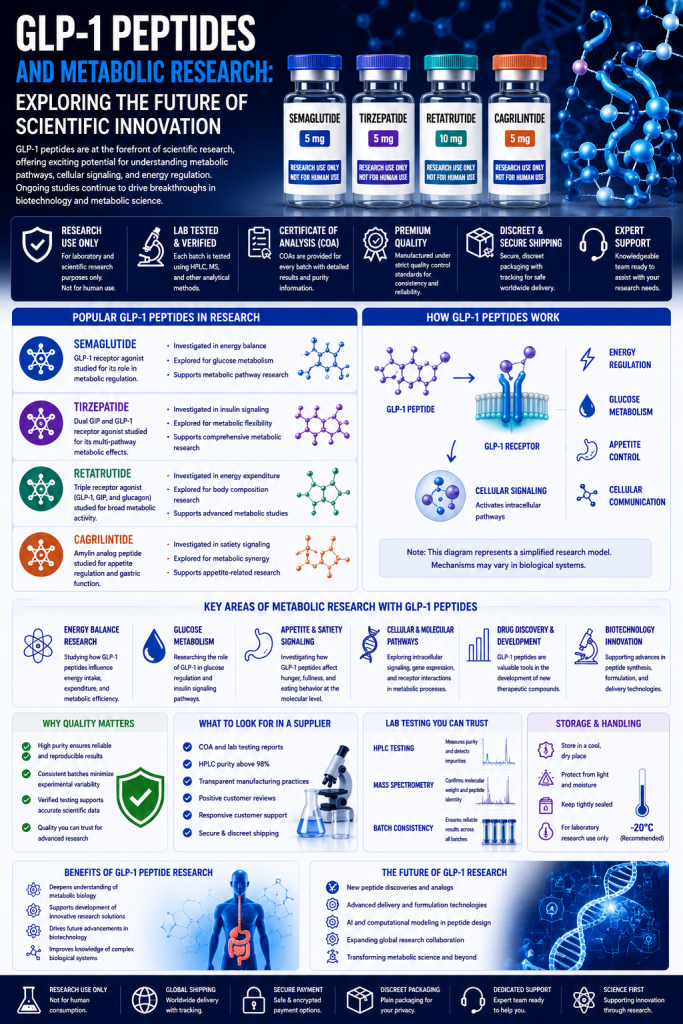
GLP-1 Peptides and Metabolic Research: Exploring the Future of Scientific Innovation
Jul
Introduction
GLP-1 peptides have become one of the most important areas of study in modern biotechnology and metabolic science. As researchers continue exploring the complex biology of metabolism, these peptides have emerged as valuable tools for investigating cellular signaling, energy regulation, and metabolic pathways.
Over the last decade, scientific publications involving GLP-1 peptides have increased dramatically. Universities, biotechnology companies, pharmaceutical researchers, and independent laboratories across North America, Europe, and Asia continue to invest heavily in understanding these naturally occurring biological messengers.
Advances in peptide synthesis, molecular biology, and analytical technologies have made it possible to study GLP-1 peptides with greater precision than ever before. Researchers are now able to examine receptor interactions, cellular communication, and metabolic signaling pathways using sophisticated laboratory methods that continue to improve every year.
As interest in metabolic science expands, demand for high-quality research peptides supported by rigorous laboratory testing has also increased. Products accompanied by Certificates of Analysis (COAs), HPLC purity reports, and Mass Spectrometry verification have become the preferred choice for researchers seeking reliable and reproducible results.
This article explores the science behind GLP-1 peptides, their role in metabolic research, current advances in biotechnology, and the factors researchers should consider when sourcing research-grade peptides.
What Are GLP-1 Peptides?
Understanding GLP-1
Glucagon-Like Peptide-1 (GLP-1) is a naturally occurring peptide that functions as a signaling molecule within the body. Scientists study GLP-1 because of its involvement in biological pathways associated with metabolism and energy regulation.
Rather than acting broadly throughout the body, GLP-1 interacts with specific receptors, making it particularly valuable for laboratory research focused on targeted biological systems.
Researchers continue studying GLP-1 peptides to improve understanding of:
- Cellular signaling
- Energy metabolism
- Nutrient regulation
- Hormonal communication
- Molecular biology
These investigations contribute to expanding knowledge of metabolic function and biological regulation.
Why GLP-1 Research Continues to Grow
Rising Interest in Metabolic Biology
Metabolism influences virtually every biological system. Scientists continue investigating how metabolic pathways regulate energy production, nutrient utilization, and cellular communication.
GLP-1 peptides provide researchers with highly specialized tools for studying these complex biological processes.
Growth in metabolic research has been driven by:
- Advances in biotechnology
- Increased scientific collaboration
- Better laboratory equipment
- Improved peptide synthesis
- Expanded molecular biology research
This has resulted in thousands of new scientific publications each year.
Precision in Biological Research
One of the greatest advantages of GLP-1 peptides is their ability to interact with highly specific biological targets.
Researchers use this precision to:
- Investigate receptor biology
- Analyze molecular signaling
- Study cellular communication
- Improve research reproducibility
- Reduce experimental variability
This makes GLP-1 peptides valuable research compounds across multiple scientific disciplines.
Popular GLP-1 Peptides Used in Research
Semaglutide
Semaglutide remains one of the most widely researched GLP-1 peptide analogs.
Current scientific studies investigate:
- Metabolic signaling
- Cellular communication
- Energy regulation
- Molecular biology
- Receptor interactions
Researchers continue publishing new findings regarding its biological mechanisms.
Tirzepatide
Tirzepatide has become another important compound in metabolic research.
Researchers study its interaction with multiple biological signaling pathways involved in metabolism and cellular regulation.
Current investigations include:
- Hormonal signaling
- Cellular adaptation
- Metabolic communication
- Biological pathway analysis
Retatrutide
Retatrutide is one of the newest peptide compounds attracting global scientific attention.
Research areas include:
- Complex metabolic biology
- Multi-receptor signaling
- Energy regulation
- Cellular response systems
Its broad research applications continue expanding.
Cagrilintide
Cagrilintide is frequently included in laboratory investigations involving metabolic signaling.
Researchers examine:
- Appetite-related pathways
- Biological communication
- Molecular interactions
- Cellular regulation
Interest in this peptide continues growing throughout the biotechnology industry.
The Role of GLP-1 in Metabolic Research
Cellular Communication
Cells communicate using complex chemical signaling systems.
Researchers investigate how GLP-1 peptides influence communication between different cell types involved in metabolic function.
Understanding these signaling networks helps scientists better understand biological regulation.
Molecular Signaling Pathways
Modern biotechnology allows researchers to observe peptide interactions at the molecular level.
Current studies explore:
- Receptor activation
- Signal transduction
- Protein interactions
- Gene regulation
- Cellular responses
These discoveries continue advancing metabolic science.
Energy Regulation Research
Energy regulation remains one of the largest areas of peptide research.
Scientists continue investigating biological systems responsible for maintaining energy balance through cellular communication and molecular signaling.
GLP-1 peptides provide valuable insight into these complex systems.
Laboratory Quality Standards
Why Peptide Purity Matters
Research accuracy depends heavily on peptide quality.
High-quality research peptides help improve:
- Experimental consistency
- Reproducibility
- Data reliability
- Scientific confidence
Professional suppliers generally provide detailed laboratory documentation supporting product quality.
Certificates of Analysis (COAs)
Researchers often request Certificates of Analysis before purchasing peptides.
A COA commonly includes:
- Product identification
- Batch number
- Purity percentage
- Laboratory testing methods
- Analytical verification
Read our related article on COA Tested Peptides to learn more.
HPLC Testing
High-Performance Liquid Chromatography remains one of the industry’s primary testing methods.
Researchers use HPLC to evaluate:
- Product purity
- Impurity levels
- Batch consistency
Reliable HPLC testing supports dependable laboratory research
Mass Spectrometry
Mass Spectrometry provides additional confirmation of peptide identity.
Scientists use this analytical technique to verify:
- Molecular weight
- Structural accuracy
- Product identity
This testing further strengthens confidence in research materials.
Choosing Reliable GLP-1 Research Peptides
Transparent Suppliers
Researchers increasingly choose suppliers that openly provide:
- Laboratory reports
- Product specifications
- COAs
- Batch verification
- Storage recommendations
Transparency supports informed purchasing decisions.
Read our guide on Supplier Transparency
Secure Packaging and Shipping
Proper packaging helps preserve peptide quality during transportation.
Professional suppliers commonly offer:
- Protective packaging
- Shipment tracking
- Secure containers
- International shipping options
Reliable logistics contribute to product integrity.
Technical Support
Quality suppliers also provide:
- Responsive customer service
- Product guidance
- Order assistance
- Technical information
Strong support improves the overall research experience.
Technology Driving Future Innovation
Artificial Intelligence
Artificial intelligence has become an important tool in peptide research.
Researchers use AI to:
- Predict molecular interactions
- Analyze biological data
- Improve experimental design
- Accelerate scientific discovery
AI continues transforming peptide science.
Improved Peptide Manufacturing
Modern manufacturing techniques now provide:
- Greater purity
- Better batch consistency
- Higher synthesis accuracy
- Enhanced quality control
These improvements benefit laboratories worldwide.Future Outlook for GLP-1 Research
The future of GLP-1 peptide research remains highly promising.
Scientists expect continued growth in:
- Biotechnology
- Molecular biology
- Pharmaceutical research
- Precision medicine
- Computational biology
As laboratory technology continues advancing, researchers will gain an even deeper understanding of metabolic signaling and peptide biology.
Demand for high-quality research peptides is expected to remain strong, with increasing emphasis on quality assurance, transparency, and analytical verification.
Conclusion
GLP-1 peptides have become one of the most important tools in modern metabolic research. Their highly targeted biological activity allows scientists to investigate complex cellular signaling pathways with remarkable precision.
As biotechnology continues advancing, researchers increasingly rely on high-quality, laboratory-tested peptides supported by transparent quality control practices. Reliable suppliers offering COAs, HPLC testing, and Mass Spectrometry verification play an important role in supporting reproducible scientific research.
The future of GLP-1 peptide research promises continued innovation, deeper biological understanding, and exciting opportunities across biotechnology and molecular science.
Frequently Asked Questions (FAQ)
What are GLP-1 peptides?
GLP-1 peptides are naturally occurring signaling molecules widely studied for their role in metabolism, cellular communication, and molecular biology.
Why are GLP-1 peptides important in research?
Researchers use them to investigate metabolic pathways, receptor biology, and cellular signaling systems.
Which GLP-1 peptides are commonly researched?
Popular compounds include Semaglutide, Tirzepatide, Retatrutide, and Cagrilintide
Why should researchers choose COA-tested peptides?
COA-tested peptides provide verified information about purity, batch consistency, and laboratory analysis.
What testing methods verify peptide quality?
Professional laboratories commonly use High-Performance Liquid Chromatography (HPLC) and Mass Spectrometry (MS) to verify peptide quality.
