
Uncategorized
Research Peptides: A Complete Guide to Their Role in Modern Scientific Research
Jul
Introduction: Why Research Peptides Are Transforming Modern Science
Research peptides have become one of the fastest-growing areas in biotechnology, molecular biology, and pharmaceutical innovation. As scientific understanding of cellular communication continues to improve, peptides are playing an increasingly important role in laboratory research around the world.
In 2026, research peptides are widely used to study biological signaling pathways, tissue biology, metabolic regulation, structural proteins, and cellular processes. Their ability to interact with highly specific molecular targets makes them valuable tools for scientists investigating complex biological systems.
The demand for high-quality research peptides has grown significantly across North America, Europe, and Asia. Universities, biotechnology companies, pharmaceutical organizations, and independent laboratories rely on peptide research to advance scientific knowledge and develop new research methods.
This comprehensive guide explores what research peptides are, how they are used in scientific studies, why quality matters, and what researchers should consider when purchasing peptides online.
What Are Research Peptides?
Understanding Research Peptides
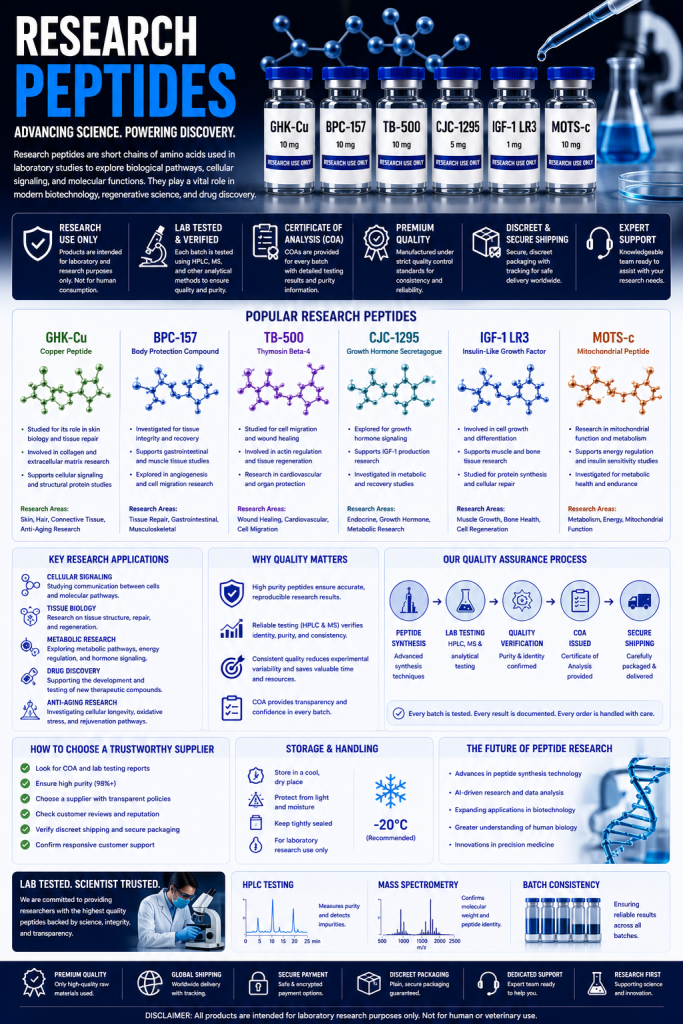
Research peptides are short chains of amino acids synthesized for use in laboratory and scientific research. They are designed to help researchers study biological pathways, molecular interactions, and cellular signaling in controlled research settings.
Unlike larger proteins, peptides have relatively simple structures while still performing highly specific biological functions. This makes them excellent tools for investigating cellular communication and biological regulation.
Research peptides are commonly used in:
- Molecular biology
- Biotechnology
- Cell culture research
- Protein interaction studies
- Metabolic pathway research
- Tissue biology
- Drug discovery
- Pharmaceutical development
Why Research Peptides Are Important
Advancing Scientific Knowledge
Peptides help researchers better understand how biological systems function at the molecular level.
Current research includes studies involving:
- Cellular signaling
- Protein regulation
- Gene expression
- Biological communication
- Structural protein interactions
Every year, new discoveries expand our understanding of peptide biology.
Precision in Laboratory Research
One reason peptides have become so popular is their ability to interact with specific biological targets.
This precision allows researchers to:
- Study individual pathways
- Reduce experimental variability
- Improve research accuracy
- Generate reproducible data
Popular Research Peptides
GHK-Cu
GHK-Cu is among the most extensively studied copper peptides.
Researchers investigate its role in:
- Skin biology
- Connective tissue research
- Cellular signaling
- Structural protein studies
Read our complete guide on GHK-Cu Peptide Functions.
BPC-157
BPC-157 is commonly researched for:
- Tissue biology
- Cellular response mechanisms
- Structural organization studies
- Biological repair pathways
TB-500
Researchers study TB-500 in relation to:
- Cellular migration
- Tissue structure
- Biological organization
- Molecular signaling
CJC-1295
Scientific studies involving CJC-1295 often focus on:
- Growth-related signaling
- Cellular communication
- Hormonal pathway research
IGF-1
IGF-1 remains an important research compound for studying:
- Cellular growth
- Protein synthesis
- Molecular regulation
- Tissue biology
GLP-1 Research Peptides
GLP-1-related peptides continue to receive significant attention in metabolic research involving:
- Energy regulation
- Metabolic signaling
- Cellular communication
- Glucose biology
Major Areas of Peptide Research
Cellular Signaling
Many peptides function as signaling molecules within biological systems.
Researchers investigate how peptides influence communication between cells and coordinate biological responses.
Tissue Biology
Peptides are frequently used to study:
- Connective tissues
- Extracellular matrix
- Structural proteins
- Cellular organization
Understanding tissue biology supports advances in regenerative science and biotechnology.
Metabolic Research
Modern metabolic studies often involve peptides that help researchers investigate:
- Energy regulation
- Nutrient utilization
- Appetite signaling
- Cellular metabolism
See our article on Weight Loss Metabolic Peptides.
Skin and Hair Biology
Copper peptides such as GHK-Cu remain important research tools for studying:
- Skin structure
- Hair follicle biology
- Extracellular matrix regulation
- Cellular renewal
Why Quality Matters
High-Purity Research Peptides
Quality plays a critical role in scientific research.
Researchers typically prioritize peptides with:
- High purity
- Batch consistency
- Verified analytical testing
- Transparent documentation
Reliable products help improve research reproducibility.
Certificates of Analysis (COAs)
A COA provides laboratory verification of peptide quality.
Researchers commonly review:
- Purity percentages
- Batch numbers
- HPLC testing
- Mass Spectrometry verification
Learn more in our guide on COA Tested Peptides.
Supplier Transparency
Professional peptide suppliers openly provide information regarding:
- Manufacturing standards
- Laboratory testing
- Product specifications
- Storage recommendations
Transparency helps researchers make informed purchasing decisions.
Read our article on Supplier Transparency.
Choosing a Reliable Research Peptide Supplier
Researchers often evaluate suppliers based on several important factors.
Laboratory Testing
Trusted suppliers provide:
- HPLC reports
- Mass Spectrometry data
- Batch verification
- Quality assurance documentation
Product Information
Professional suppliers typically include:
- Product descriptions
- Storage instructions
- Purity specifications
- COA availability
Customer Support
Reliable customer support is another sign of a professional supplier.
Researchers appreciate:
- Fast responses
- Technical assistance
- Order tracking
- Clear communication
Shipping Standards
Secure shipping practices help maintain peptide quality.
Professional suppliers often offer:
- Temperature-conscious packaging
- Batch labeling
- Secure containers
- Shipment tracking
Technology Driving Peptide Research
Artificial Intelligence
Artificial intelligence is transforming peptide research by helping scientists:
- Predict peptide interactions
- Analyze biological data
- Improve experimental design
- Discover new peptide candidates
Advanced Peptide Synthesis
Modern synthesis technologies continue improving:
- Purity
- Batch consistency
- Sequence accuracy
- Manufacturing efficiency
These advancements support increasingly reliable research.
Future Trends in Research Peptides
Continued Industry Growth
Global demand for research peptides is expected to continue increasing as biotechnology expands.
Researchers anticipate growth in:
- Pharmaceutical development
- Molecular biology
- Regenerative science
- Precision medicine research
Greater Focus on Transparency
Researchers increasingly prefer suppliers that provide:
- Verified laboratory testing
- COAs
- Batch traceability
- Educational resources
Transparency is becoming a major competitive advantage.
Higher Quality Standards
Industry expectations continue rising regarding:
- Product purity
- Manufacturing consistency
- Quality assurance
- Laboratory verification
These improvements support stronger scientific research worldwide.
Conclusion
Research peptides continue to shape the future of biotechnology and molecular science. Their precision, versatility, and growing range of applications make them essential tools for modern laboratory research.
As the industry evolves, researchers increasingly rely on high-quality, COA-tested peptides supplied by transparent companies with strong quality control systems. Choosing verified research peptides helps improve reproducibility, confidence, and scientific success.
Frequently Asked Questions (FAQ)
What are research peptides?
Research peptides are short chains of amino acids used in laboratory studies to investigate biological processes and molecular signaling pathways.
Why are research peptides important?
They help scientists study cellular communication, protein interactions, metabolism, tissue biology, and many other areas of biotechnology.
Why should researchers choose COA-tested peptides?
Certificates of Analysis help verify peptide identity, purity, and laboratory testing results.
How can researchers identify trustworthy peptide suppliers?
Researchers typically review laboratory testing, supplier transparency, customer feedback, and product documentation.
What is the future of peptide research?
The field is expected to continue expanding through advances in biotechnology, artificial intelligence, peptide synthesis, and molecular science.
