
Uncategorized
Most Popular Peptides for Anti-Aging Research in 2026: Trends, Science, and Innovation
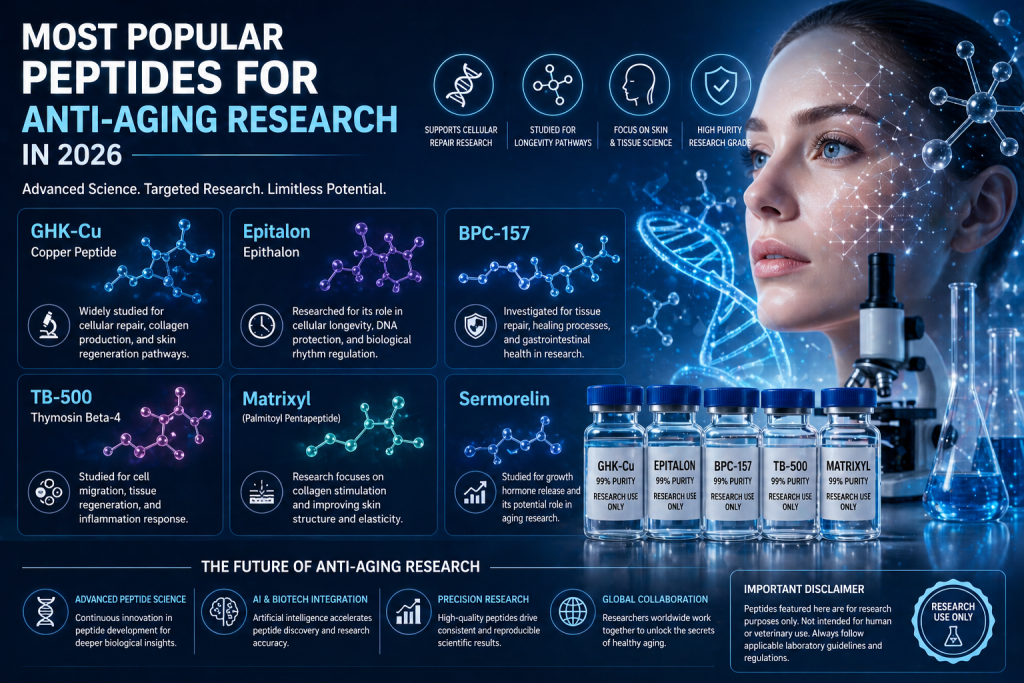
Apr
Introduction: Why Anti-Aging Peptide Research Is Growing Rapidly
Anti-aging research has become one of the most active and fast-growing areas in modern science. In 2026, peptides are at the center of this movement due to their ability to interact with biological systems in highly specific ways. Researchers are increasingly exploring peptides as tools for studying cellular aging, skin biology, and molecular repair mechanisms.
The growing demand for precision-based research has pushed peptides into the spotlight. Their customizable structure and compatibility with advanced laboratory techniques make them ideal for investigating age-related biological processes.
This article explores the most popular peptides currently studied in anti-aging research, how they are used in scientific environments, and why they continue to gain global attention.
Understanding Peptides in Anti-Aging Research
What Are Anti-Aging Peptides?
Anti-aging peptides are short chains of amino acids studied for their role in cellular processes associated with aging. These processes may include cellular signaling, structural protein interactions, and biological regulation mechanisms.
In research settings, peptides are used to explore how biological systems change over time and how these changes can be measured or influenced at the molecular level.
Why Peptides Are Important in Aging Studies
Peptides offer several advantages in anti-aging research:
- Targeted interaction with biological pathways
- High specificity in molecular studies
- Flexible sequence design
- Compatibility with laboratory analysis tools
- Ability to model natural biological signals
These features make peptides valuable tools for studying complex biological systems related to aging.
Most Popular Peptides for Anti-Aging Research in 2026
GHK-Cu (Copper Peptide)
GHK-Cu is one of the most widely studied peptides in anti-aging research. It is known for its role in biological signaling and its interaction with cellular repair processes.
Researchers study GHK-Cu for:
- Cellular regeneration mechanisms
- Structural protein interactions
- Skin-related biological processes
Its consistent presence in scientific literature makes it a key focus in peptide-based aging studies.
Epitalon (Epithalon)
Epitalon is another peptide frequently studied in aging research. It has been explored for its potential role in cellular regulation and biological timing processes.
Research areas include:
- Cellular lifespan studies
- DNA-related mechanisms
- Biological rhythm regulation
Epitalon continues to attract attention due to its connection with long-term cellular processes.
BPC-157
BPC-157 is widely researched for its interaction with biological repair systems. Scientists use it to study how tissues respond to environmental stress and recovery processes.
Key research interests include:
- Tissue repair mechanisms
- Cellular response pathways
- Structural integrity studies
Thymosin Beta-4 (TB-500)
Thymosin Beta-4 is studied for its involvement in cellular movement and repair processes. It plays a role in understanding how cells respond to damage and regenerate.
Researchers explore:
- Cellular migration
- Tissue structure
- Biological repair pathways
Matrixyl (Palmitoyl Pentapeptide)
Matrixyl is commonly studied in skin-related research. It is known for its interaction with structural proteins such as collagen.
Research applications include:
- Skin structure analysis
- Collagen interaction studies
- Surface-level biological modeling
How These Peptides Are Used in Research
Laboratory-Based Investigations
These peptides are primarily used in controlled laboratory environments to study biological processes. Researchers focus on understanding how peptides interact with cells, proteins, and molecular pathways.
Modeling Biological Aging
Peptides allow scientists to model specific aspects of aging, such as:
- Cellular signaling changes
- Structural protein breakdown
- Biological repair responses
This helps researchers better understand how aging occurs at a molecular level.
Advances Driving Anti-Aging Peptide Research
Artificial Intelligence and Peptide Design
AI is transforming how peptides are studied. Researchers can now predict peptide behavior before synthesis, improving efficiency and reducing experimental errors.
Improved Synthesis and Purity Standards
Modern peptide synthesis technologies allow for higher purity and more accurate sequences. This improves the reliability of anti-aging research studies.
Challenges in Anti-Aging Peptide Research
Complexity of Aging Processes
Aging is influenced by multiple biological systems, making it difficult to isolate single factors. Peptides help simplify these studies but cannot fully represent complex systems on their own.
Need for Standardized Research Protocols
Different laboratories may use different methods, leading to variability in results. Standardized protocols are essential for improving consistency.
Ethical and Research Considerations
Research Use Only
Peptides discussed in this article are intended for research purposes only. They are not approved for general or unsupervised use.
Importance of Scientific Integrity
Accurate reporting and responsible research practices are essential for advancing knowledge in anti-aging science.
The Future of Anti-Aging Peptides
Increased Global Research Interest
More institutions are investing in peptide research, especially in areas related to aging and cellular biology.
Integration with Emerging Technologies
Peptide research is increasingly combined with:
- Artificial intelligence
- Biotechnology platforms
- Advanced molecular analysis tools
This integration is expected to accelerate discoveries in the coming years.
Frequently Asked Questions (FAQ)
What are peptides in anti-aging research?
They are short amino acid chains studied for their role in biological processes related to aging.
Why are peptides popular in aging studies?
They allow precise investigation of molecular interactions and cellular processes.
Are these peptides used outside research?
They are primarily intended for controlled scientific research environments.
What makes GHK-Cu popular?
Its involvement in cellular repair and structural protein interactions.
What is the future of anti-aging peptide research?
Continued growth driven by technology, global collaboration, and scientific innovation.
