
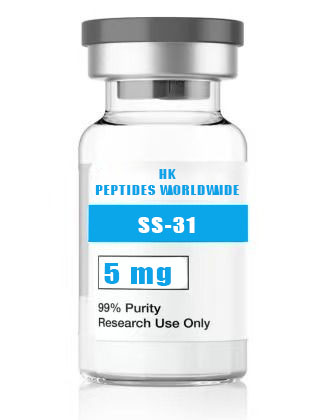
Buy SS-31 5 mg Research Peptide USA
Original price was: $87.00.$76.00Current price is: $76.00.
Bulk Price for 10 Vials.
SS-31 5 mg is a synthetic mitochondrial-targeting peptide studied for its interactions with mitochondrial membranes and cellular energy pathways. Intended strictly for laboratory research purposes, not for human or veterinary use.
SS-31 5mg Precision Mitochondrial Research Peptide USA
SS-31 5mg is a research-grade mitochondrial peptide supplied in the United States for laboratory investigation of mitochondrial function, cellular energetics, and oxidative stress pathways. Often referred to as elamipretide or by the sequence name D-Arg-Dmt-Lys-Phe-NH2, this synthetic tetrapeptide is studied for its reported interaction with cardiolipin on the inner mitochondrial membrane. Researchers seeking a precise, documented format for in vitro and preclinical work can review the product listing and laboratory peptide catalog before ordering.
This description explains what the 5mg format offers, how researchers typically evaluate it, storage and handling expectations, and what to look for in a US supplier. It is written for laboratory and academic buyers who need clear specifications rather than marketing claims.
What Is SS-31 5mg?
SS-31 is a small synthetic peptide composed of four amino acids, including a dimethyltyrosine residue that supports its antioxidant behavior in experimental models. In mitochondrial research, it is most often discussed in relation to cardiolipin binding and the protection of cristae structure. The 5mg vial size suits pilot studies, dose-ranging experiments, and small assay batches where reconstitution volume and cost both matter.
The compound is supplied for research use only. It is not a drug, dietary supplement, or therapeutic product, and it is not intended for human or veterinary administration. Buyers should confirm this classification before purchase, because the regulatory status of research peptides in the United States differs from that of approved medicines.
Why the 5mg Format Matters
A 5mg vial is a practical middle ground. It is large enough for multiple experimental conditions but small enough to avoid the waste that comes with bulk containers when a study is still in early phases. Laboratories that need to compare concentrations or repeat assays can plan reconstitution volumes with straightforward arithmetic, which reduces handling errors.
Researchers often ask about SS-31 5 mg formats specifically because smaller vials support tighter inventory control. If a project scales up, moving to wholesale or bulk supply becomes a separate purchasing decision rather than a commitment made up front.
Purity and Research Grade Explained
Research grade typically means the peptide is produced by solid-phase synthesis, purified by high-performance liquid chromatography, and verified by mass spectrometry. A certificate of analysis should accompany the batch and report purity, molecular weight, appearance, and testing method. Reputable suppliers publish these documents or provide them on request.
Purity is reported as a percentage, and values in the high range are common for well-documented research peptides. The exact figure for any specific lot should always come from that lot’s certificate rather than from general marketing language.
How Researchers Approach Mitochondrial Studies
Mitochondrial research spans isolated organelle assays, cell culture models, and preclinical animal work. SS-31 appears in this literature as a tool compound for probing cardiolipin-dependent processes, electron transport chain behavior, and reactive oxygen species generation. Investigators usually begin with a literature review to establish published concentration ranges and controls before designing new experiments.
Good study design includes vehicle controls, replicate wells, and independent validation methods such as fluorescence-based membrane potential assays or respiration measurements. Because mitochondrial readouts are sensitive to handling and timing, consistency in reconstitution and storage matters as much as the starting purity.
Reconstitution and Handling
SS-31 is generally reconstituted in sterile water or an appropriate buffer according to the batch documentation supplied with the vial. Researchers should avoid vigorous vortexing, which can introduce bubbles and destabilize some peptides. Gentle mixing and brief centrifugation usually suffice.
Working aliquots reduce freeze–thaw cycles, which are a common cause of degradation. Labeling aliquots with date and concentration helps maintain traceability across a long study.
Storage and Stability Considerations
Lyophilized peptide is typically stored cold and protected from light and moisture. Once reconstituted, solutions are usually kept refrigerated for short-term use and frozen for longer storage, following the supplier’s specific guidance. Stability data applies to the documented conditions, so deviations should be treated as variables rather than assumed safe.
Buying SS-31 Peptide in the USA: What to Check
US buyers should evaluate documentation, shipping conditions, and supplier transparency before placing an order. A peptide that arrives without batch-specific analysis is difficult to defend in a methods section. The most useful checklist includes a certificate of analysis, clear product specifications, cold-chain or insulated packaging, and responsive technical support.
Ordering domestically also simplifies transit time and reduces exposure to temperature swings during shipping. Buyers can browse research peptides organized by format and request documentation before committing to a purchase. Price should be weighed against verification and handling, not treated as the only variable.
Research Grade Verification
Ask whether purity testing is performed in-house or by an independent laboratory, and confirm that the certificate matches the lot number on the vial. Mass spectrometry confirms molecular identity, while chromatography addresses purity. Both matter for reproducibility.
SS-31 Peptide Price Factors
SS-31 peptide price in the US varies with vial size, purity, documentation, and shipping method. A 5mg vial generally costs less than larger formats, though the cost per milligram may be higher. Comparing cost per milligram alongside the certificate of analysis gives a clearer picture than the vial sticker price alone.
Wholesale and Bulk Supply
Labs planning repeated studies, core facilities, and distributors often move to SS-31 peptide wholesale or bulk supply arrangements. These orders should still include lot-specific documentation for each batch, since documentation quality does not become less important at volume. Discuss lead times and storage capacity before ordering bulk quantities.
Who This Product Serves
The primary audience is academic and industry researchers studying mitochondrial biology, plus laboratory managers responsible for procurement. A secondary audience includes distributors who supply research institutions and need a consistent US-based source. Both groups benefit from clear specifications, predictable packaging, and accessible batch records.
If you are a researcher new to the compound, start with a small vial and a defined pilot protocol. If you manage a lab, compare suppliers on documentation, not on website claims alone, and keep certificates on file for audit and publication purposes.
Comparing SS-31 With Other Mitochondrial Research Peptides
SS-31 is often discussed alongside other mitochondria-targeted compounds, but they are not interchangeable. Its short sequence and cardiolipin interaction distinguish it from longer peptides studied for different pathways. Researchers should match the tool compound to the specific question rather than assuming overlap in mechanism.
The table below summarizes practical buying considerations rather than biological effects.
| Consideration | What to Confirm |
|---|---|
| Format | 5mg vial vs. larger or bulk sizes |
| Documentation | Lot-specific certificate of analysis, identity testing |
| Storage | Cold, light-protected; follow supplier guidance |
| Ordering | Domestic shipping, lead time, packaging |
| Use | Research only, not for human or veterinary use |
Frequently Asked Questions
What is SS-31 5mg used for in research?
It is used as a tool compound in laboratory studies of mitochondrial function, cardiolipin interactions, and oxidative stress. It is not approved for therapeutic use, and it is not sold for human consumption.
How is SS-31 peptide shipped in the USA?
Most suppliers ship lyophilized vials with insulated or cold packaging to limit temperature exposure. Confirm shipping method and expected transit time before ordering, especially in warm months.
What affects SS-31 peptide price?
Vial size, purity, testing documentation, and shipping terms all influence price. Comparing cost per milligram alongside the certificate of analysis gives a more useful measure than the listed vial price.
Do you offer SS-31 peptide wholesale or bulk supply?
Labs and distributors can request bulk quantities for ongoing or multi-site work. Ask for lot-specific documentation, lead times, and storage guidance with any wholesale inquiry.
What should a certificate of analysis include?
It should report lot number, purity percentage, testing method, molecular weight, appearance, and the date of analysis. Researchers should match the lot number to the vial label before use.
Can I store reconstituted SS-31 long term?
Long-term storage of reconstituted solutions is generally avoided in favor of aliquoting and freezing per supplier guidance. Follow the batch documentation, and record storage conditions in your lab notebook.
Be the first to review “Buy SS-31 5 mg Research Peptide USA”
Related products
Research Grade Peptide
Research Grade Peptide
Research Grade Peptide
Research Grade Peptide
Research Grade Peptide
Research Grade Peptide
Research Grade Peptide

Research Grade Peptide
Reviews
There are no reviews yet.